
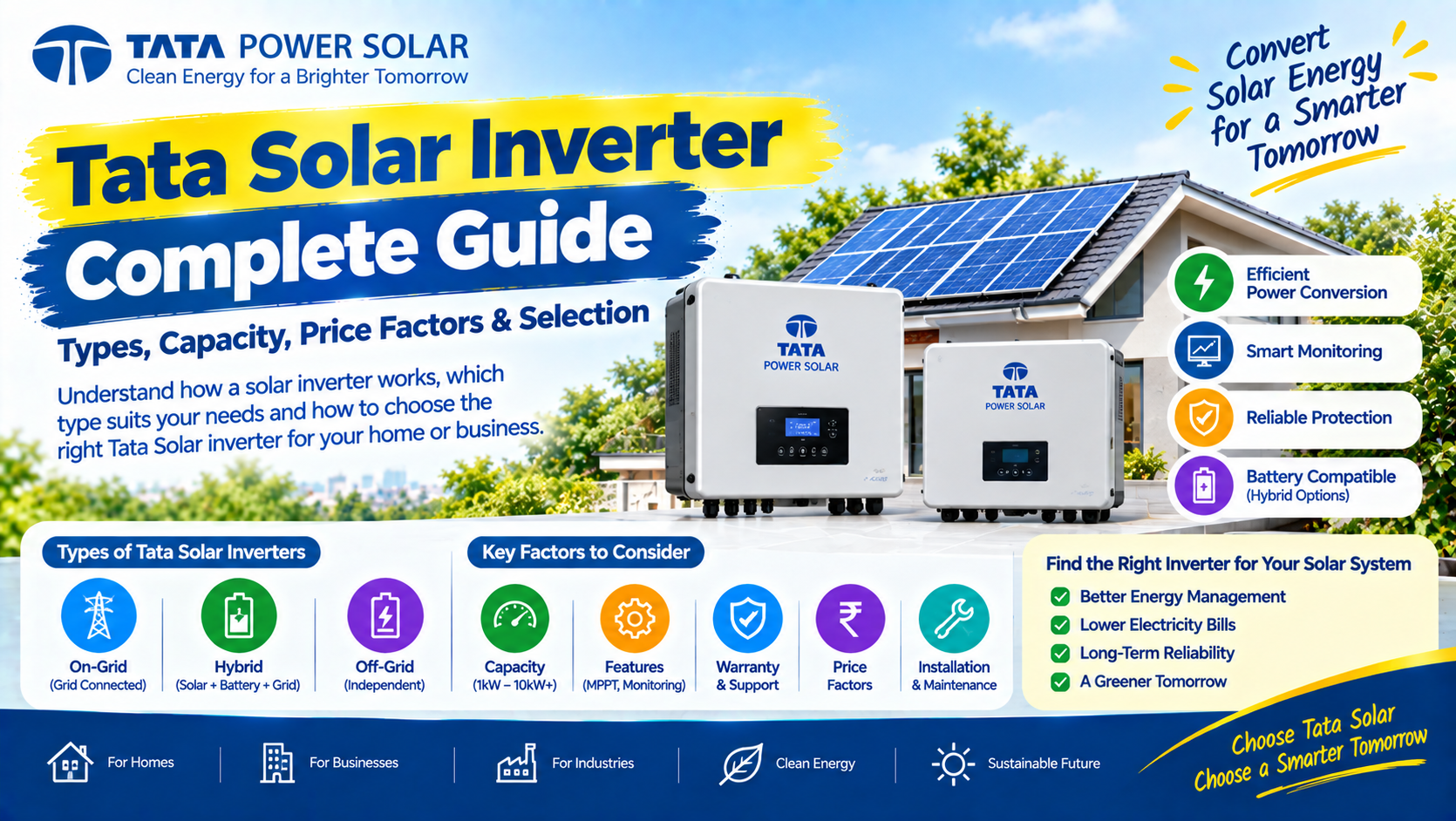
A solar inverter is one of the most important components of a rooftop solar system. Solar panels generate electricity in DC form, while most household and commercial appliances use AC electricity. The inverter helps convert and manage this electricity so it can be used by the property.
For homeowners considering a Tata Power Solar rooftop system, understanding the role of the inverter is essential before selecting a system.
But which inverter should you choose? What capacity do you need? What is the difference between on-grid and hybrid inverters? How does an inverter affect solar performance? And what factors influence the total price?
This detailed guide answers these questions using the W5H approach: What, Why, Who, Where, When and How.
What Is a Solar Inverter?
A solar inverter is an electrical device that converts the DC electricity produced by solar panels into AC electricity that can be used by electrical appliances.
The basic process is:
Sunlight → Solar Panels → DC Electricity → Solar Inverter → AC Electricity → Home/Business
In addition to converting electricity, modern solar inverters can provide functions such as:
- System monitoring
- Grid synchronization
- Electrical protection
- Fault detection
- Energy management
- Battery management in compatible systems
The exact features depend on the inverter type and model.
What Is a Tata Power Solar Inverter?
A Tata Power Solar inverter is an inverter used as part of a solar power solution associated with Tata Power Solar.
Depending on the system configuration, an inverter solution may be designed for:
- Residential rooftop solar
- Commercial solar
- Industrial applications
- Grid-connected systems
- Battery-based systems
- Hybrid solar systems
The appropriate inverter depends on the solar panel capacity, electrical configuration, battery requirements and installation conditions.
Why Is the Solar Inverter Important?
Solar panels alone cannot provide the complete electrical interface required by a typical home.
The inverter plays several important roles.
1. Converts Solar Electricity
Solar panels generate DC electricity.
The inverter converts it into AC electricity suitable for the property's electrical system.
2. Helps Manage Solar Generation
The inverter manages the electrical output from the solar array according to the system design.
3. Enables System Monitoring
Many modern inverters can provide information about:
- Daily generation
- Monthly generation
- Current output
- System status
- Faults
- Historical performance
4. Supports Grid Integration
In an on-grid system, the inverter is designed to operate in coordination with the electricity grid.
5. Supports Battery Storage
Compatible hybrid or battery-capable inverters can manage energy flowing between solar panels, batteries, the grid and household loads.
Who Needs a Tata Solar Inverter?
A solar inverter is required as part of most conventional rooftop photovoltaic systems.
It can be relevant for:
Homeowners
For homes installing rooftop solar to generate electricity and reduce grid electricity consumption.
Commercial Properties
Businesses can use appropriately sized solar systems to generate electricity for offices, shops, factories and other facilities.
Industrial Users
Larger solar installations require appropriately designed inverter systems based on the project's electrical architecture.
Solar Dealers and Installers
Dealers and installers need to match the inverter with the solar modules, system capacity, electrical connection and customer requirements.
Where Is the Solar Inverter Installed?
The inverter is generally installed in a suitable location near the solar electrical equipment and building electrical connection.
The exact location depends on:
- System design
- Cable length
- Ventilation
- Weather protection
- Accessibility
- Electrical safety
- Manufacturer installation requirements
A suitable inverter location should provide adequate ventilation and protection from unsuitable environmental conditions.
It should also remain accessible for inspection and maintenance.
When Do You Need to Choose the Inverter?
The inverter should be considered before the solar system is finalized, rather than treating it as an afterthought.
During system planning, the installer should evaluate:
- Solar panel capacity
- Number of panels
- Panel electrical characteristics
- Household load
- Grid connection
- Battery requirement
- Backup requirement
- Future expansion
- Roof conditions
- Local electrical requirements
Correct inverter selection can help ensure that the solar system operates appropriately.
How Does a Tata Solar Inverter Work?
The basic working process is straightforward.
Step 1: Solar Panels Receive Sunlight
Solar modules convert sunlight into DC electricity.
Step 2: DC Electricity Reaches the Inverter
The generated electricity travels through the solar system's DC wiring to the inverter.
Step 3: Inverter Converts DC to AC
The inverter converts the electricity into AC electricity suitable for the property's electrical system.
Step 4: Electricity Powers Loads
Solar electricity can be used by appliances and other connected loads.
Step 5: Excess Electricity
Depending on the system type and applicable electricity arrangement, surplus electricity may be sent to the grid or stored in a battery.
Types of Solar Inverters
Choosing the right inverter starts with understanding the main system categories.
1. On-Grid Solar Inverter
An on-grid inverter is designed for a solar system connected to the utility grid.
Typical energy flow:
Solar Panels → Inverter → Home
Excess electricity may be exported to the grid according to the applicable metering arrangement.
Suitable For
- Homes connected to the electricity grid
- Businesses
- Users primarily interested in reducing grid electricity consumption
An important point is that a standard grid-connected solar system generally does not provide backup power during a grid outage unless specifically designed with compatible backup equipment.
2. Hybrid Solar Inverter
A hybrid inverter can manage solar generation, battery storage, household loads and grid electricity in a compatible system.
Possible energy flows include:
Solar → Home
Solar → Battery
Battery → Home
Grid → Home
Suitable For
Homeowners who want:
- Solar generation
- Battery storage
- Backup capability
- Greater energy-management flexibility
3. Off-Grid Inverter
An off-grid inverter is used in a system designed to operate without depending on the utility grid.
A typical configuration can include:
Solar Panels + Battery + Inverter + Loads
Battery storage is generally an important part of an off-grid system because solar generation is not continuously available.
What Solar Inverter Capacity Do You Need?
Inverter sizing should be based on the overall solar-system design rather than simply selecting an inverter with the same number as the solar-panel capacity.
Common residential solar-system sizes include:
- 1 kW
- 2 kW
- 3 kW
- 3.5 kW
- 5 kW
- 6 kW
- 6.5 kW
- 10 kW and above
The appropriate inverter depends on the specific system design and manufacturer specifications.
For example, a 3 kW rooftop solar system needs an inverter selected according to:
- Panel configuration
- DC capacity
- AC output requirements
- MPPT requirements
- Grid connection
- Electrical characteristics
- Applicable design limits
Therefore, do not select an inverter based only on the headline kW number.
What Is MPPT in a Solar Inverter?
MPPT stands for Maximum Power Point Tracking.
Solar panels do not produce exactly the same voltage and current throughout the day.
Their electrical output changes according to:
- Sunlight intensity
- Temperature
- Shading
- Panel characteristics
An MPPT system helps the inverter operate the solar array around an appropriate operating point to extract available power.
The number of MPPT inputs can also be important when designing systems with different roof orientations or multiple solar-panel strings.
Tata Solar Inverter Price: What Determines the Cost?
There is no single universal inverter price because the cost depends on the specific model and system requirements.
Important price factors include:
Inverter Capacity
A larger inverter generally has a different price from a smaller residential inverter.
Inverter Type
On-grid, hybrid and off-grid systems have different features and architectures.
Number of MPPTs
Inverter configuration and MPPT capability can affect equipment selection and pricing.
Monitoring Features
Advanced monitoring and communication features can affect the overall equipment specification.
Battery Compatibility
Hybrid or storage-capable equipment may have additional functionality compared with a basic grid-tied inverter.
Installation
The final solar-system cost can also include:
- Installation
- Mounting
- Cabling
- Protection devices
- Earthing
- Commissioning
- Monitoring setup
For this reason, compare the complete system quotation, not just the inverter's listed price.
Tata Solar Inverter vs Solar Panel
The solar panel and inverter perform different jobs.
| Component | Main Function |
|---|---|
| Solar Panel | Converts sunlight into DC electricity |
| Solar Inverter | Converts/manages electrical power |
| Solar Battery | Stores electricity |
| Mounting Structure | Supports solar panels |
| Protection Equipment | Helps protect the electrical system |
| Monitoring System | Tracks system performance |
A rooftop solar system works as an integrated system rather than as a collection of unrelated components.
How to Choose the Right Tata Solar Inverter
Use the following checklist when comparing inverter options.
1. Determine Your Solar System Size
Start with your required solar capacity.
Your electricity consumption and available roof area can help determine the overall system size.
2. Choose the System Type
Ask yourself:
Do I need only grid-connected solar?
Or:
Do I also need battery backup?
This helps determine whether an on-grid or hybrid configuration should be evaluated.
3. Check Inverter Capacity
The inverter should be compatible with the planned solar array and electrical loads.
4. Check MPPT Configuration
If your roof has multiple orientations or different panel strings, MPPT configuration becomes particularly important.
5. Check Monitoring
Consider whether the inverter provides the monitoring information you want.
Useful information can include:
- Daily generation
- Monthly generation
- Current output
- System alerts
- Historical data
6. Check Warranty
Before buying, carefully review:
- Product warranty
- Warranty duration
- Warranty conditions
- Service process
- Authorized service availability
Warranty terms can vary by product and should be confirmed from the relevant documentation.
Tata Solar Inverter for a 3kW Solar System
A 3 kW solar system is commonly considered for residential rooftop applications.
However, choosing the inverter requires more than simply searching for a "3 kW inverter."
The installer should consider:
- Number of solar panels
- Panel wattage
- String configuration
- DC voltage
- Current
- MPPT range
- AC output
- Grid requirements
- Future expansion
- Installation location
The final inverter should match the technical specifications of the selected solar modules and the overall system design.
Tata Solar Inverter for a 5kW Solar System
A 5 kW rooftop system can be suitable for properties with higher electricity consumption.
The inverter selection should consider:
- Expected solar generation
- Household demand
- Panel configuration
- Grid connection
- MPPT requirements
- Required monitoring
- Future expansion
If battery backup is required, a compatible hybrid inverter and correctly sized battery should be considered as part of the system design.
Solar Inverter and Battery: Do You Need Both?
Not necessarily.
On-Grid System
Solar Panels → On-Grid Inverter → Home/Grid
Battery is not necessarily required.
Hybrid System
Solar Panels → Hybrid Inverter → Home + Battery + Grid
Battery storage is part of the design.
Off-Grid System
Solar Panels → Inverter → Battery → Loads
Battery storage is generally essential to operate when solar generation is unavailable.
What Happens to the Inverter During a Power Cut?
This depends on the type of solar system.
A standard grid-connected inverter generally shuts down during a grid outage to prevent unsafe electricity from being supplied to the utility network.
A properly designed backup or hybrid system can continue supplying selected loads using battery storage and appropriate backup functionality.
This distinction is important when buying rooftop solar.
Solar Inverter Efficiency
Solar inverter efficiency describes how effectively the inverter converts electrical energy from one form to another.
However, the total solar-system performance depends on more than inverter efficiency.
Other factors include:
- Solar panel efficiency
- Temperature
- Shading
- Dust
- Wiring losses
- Orientation
- Tilt
- System downtime
- Maintenance
- Grid conditions
Therefore, a high-quality inverter is important, but it should be evaluated as part of the complete solar system.
How to Maintain a Solar Inverter
Solar inverters generally require less routine maintenance than some other solar components, but monitoring and inspection remain important.
Check the Display or Monitoring App
Look for:
- Error messages
- Abnormal output
- Unexpected shutdowns
- Communication failures
Keep the Area Clear
Do not block the inverter's ventilation area.
Inspect Cables
Visible cable damage should be investigated by a qualified professional.
Monitor Generation
A sudden reduction in solar generation can indicate an inverter or system problem.
Follow Manufacturer Instructions
Always follow the specific inverter manufacturer's maintenance and safety instructions.
Common Solar Inverter Problems
Some common issues include:
- Inverter shutdown
- Grid fault
- Over-temperature warning
- Communication failure
- Low solar input
- DC isolation fault
- AC fault
- MPPT-related issues
The exact meaning of an error code depends on the inverter model.
Do not attempt electrical repairs yourself unless you are qualified to do so.
10 Questions to Ask Before Buying a Solar Inverter
Before finalizing your solar quotation, ask:
- What inverter model is included?
- What is its rated capacity?
- Is it on-grid or hybrid?
- How many MPPTs does it have?
- What panel configuration is recommended?
- Is battery storage supported?
- What monitoring features are included?
- What is the warranty?
- Who provides after-sales service?
- What is included in the complete installation quotation?
These questions can help you compare quotations more accurately.
Tata Solar Inverter Buying Checklist
Before placing an order, verify:
Solar Capacity: ______ kW
Inverter Type: On-grid / Hybrid / Off-grid
Inverter Capacity: ______ kW
MPPT Inputs: ______
Battery Required: Yes / No
Monitoring: App / Web / Display
Warranty: ______
Installation Included: Yes / No
Protection Equipment: Yes / No
Earthing: Yes / No
Commissioning: Yes / No
After-Sales Support: ______
Keeping these details in the quotation can make system comparisons easier.
Frequently Asked Questions
1. What does a Tata Solar inverter do?
A solar inverter converts DC electricity generated by solar panels into AC electricity used by household or commercial electrical systems, while compatible models can also provide monitoring and energy-management functions.
2. Which inverter is best for a home?
The appropriate inverter depends on your solar capacity, electricity consumption, grid connection, battery requirements, roof configuration and desired features. There is no single inverter configuration that suits every home.
3. Do I need a battery with a solar inverter?
Not always. A basic grid-connected rooftop solar system can operate without battery storage. A battery becomes relevant when backup or energy storage is required.
4. What inverter do I need for a 3kW solar system?
You need an inverter that is compatible with the specific 3 kW solar array, including its voltage, current, string configuration and AC requirements. The exact model should be selected using the manufacturer's technical specifications and system design.
5. What is MPPT in a solar inverter?
MPPT means Maximum Power Point Tracking. It helps the inverter operate the solar array at an appropriate electrical operating point to extract available power under changing conditions.
6. Does a solar inverter work during a power cut?
A standard grid-connected inverter normally shuts down when the grid fails. A compatible hybrid or backup system can provide power to supported loads during an outage.
7. How long does a solar inverter last?
Inverter lifespan depends on the model, operating environment, installation quality, usage and maintenance. Always check the specific manufacturer's warranty and technical documentation.
8. Can a solar inverter be upgraded later?
Some systems can be expanded or upgraded, but compatibility must be checked before adding panels, batteries or another inverter.
9. Does a solar inverter reduce electricity bills?
The inverter itself does not reduce electricity consumption. It enables solar electricity generated by the panels to be converted and used by the property's electrical system, which can reduce the amount of electricity purchased from the grid when the solar system generates power.
10. How do I compare Tata Solar inverter quotations?
Compare the complete system rather than just the inverter price. Check capacity, model, MPPT configuration, warranty, monitoring, installation, protection equipment, battery compatibility and after-sales service.
Conclusion
The solar inverter is the electrical heart of a rooftop solar system, converting and managing the electricity generated by solar panels.
Choosing the right inverter requires more than selecting a kW rating. You should consider your solar capacity, electricity consumption, panel configuration, MPPT requirements, grid connection, battery needs, monitoring features, warranty and installation conditions.
Whether you are planning a 1 kW, 3 kW, 5 kW, 6.5 kW or larger rooftop solar system, the inverter should be selected as part of a complete system design.
A properly matched inverter can help your solar system operate reliably and make it easier to monitor your clean-energy generation over the long term.
Found this useful?
Share this solar business article.