
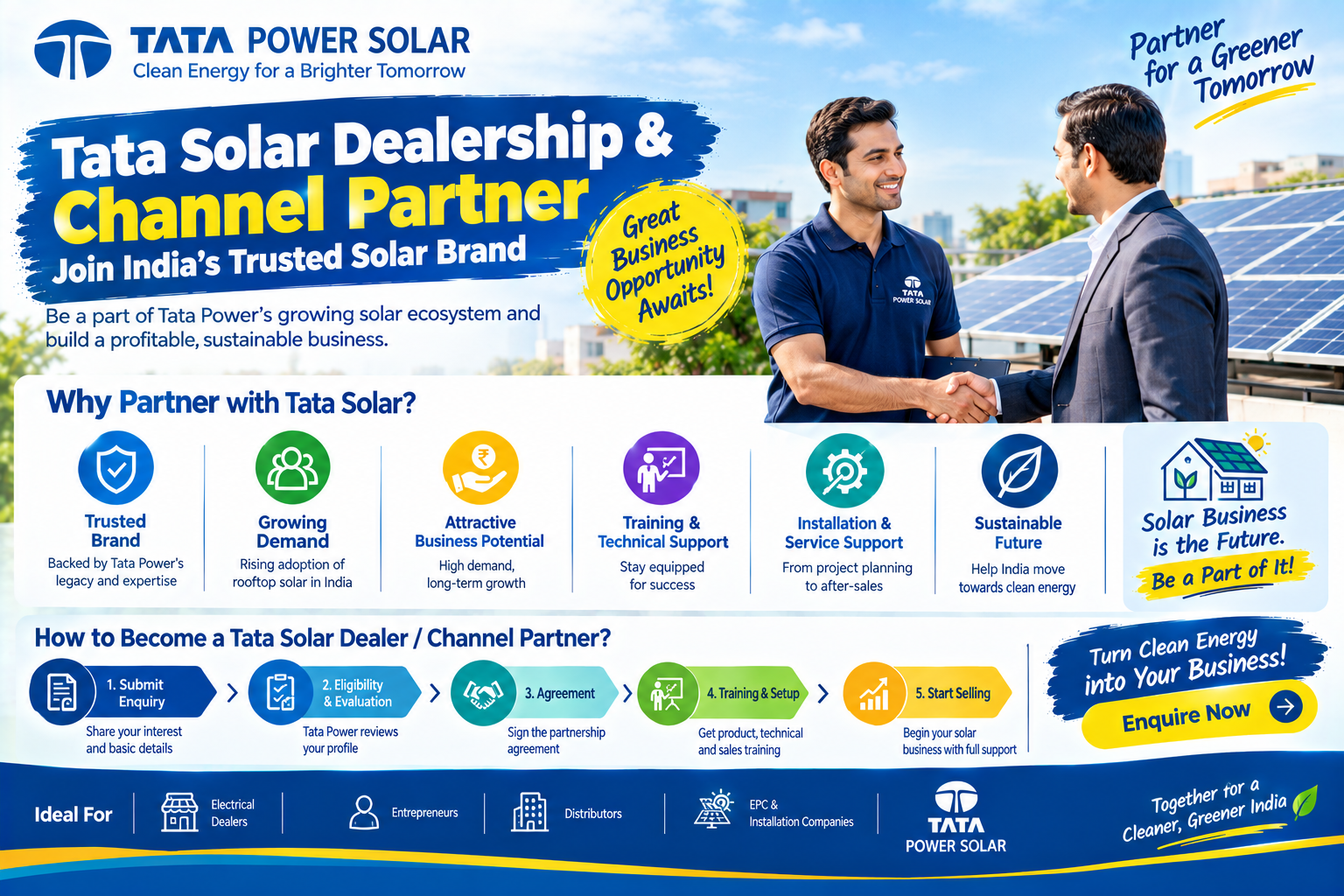
India's rooftop solar market is creating opportunities for entrepreneurs, electrical businesses, renewable-energy professionals and local distributors who want to build a business around clean energy.
For people interested in the Tata Solar dealership, distributorship or channel-partner business, one of the most important questions is how the partnership model works and what is required to operate successfully.
Tata Power's current solar business includes a nationwide ecosystem of channel partners and authorised service partners. In September 2026, Tata Power reported that Tata Power Solaroof had crossed 5 lakh rooftop solar installations, supported by 700+ channel partners and 250+ authorised service partners across India.
This guide explains the What, Why, Who, Where, When and How of starting a solar dealership-focused business.
What Is a Tata Solar Dealership?
A Tata Solar dealership or channel-partner business involves participating in Tata Power's solar sales and service ecosystem under the applicable partner structure.
The exact commercial arrangement, eligibility, territory, products, responsibilities and onboarding terms should be confirmed directly with Tata Power because these can vary over time.
Tata Power currently provides a channel partner locator and customer-facing solar dealer network on its official website.
For an entrepreneur, the opportunity can involve activities such as:
- Generating solar leads
- Customer consultation
- Site surveys
- Solar quotations
- System coordination
- Customer documentation
- Installation coordination
- After-sales support
- Local marketing
The exact responsibilities depend on the partner agreement.
Why Start a Tata Solar Dealership Business?
The rooftop solar market offers several potential business opportunities.
Growing Customer Interest
Homeowners and businesses are increasingly researching rooftop solar to reduce electricity costs and generate renewable energy.
Multiple Customer Segments
A solar dealership can potentially serve:
- Residential customers
- Shops
- Offices
- Commercial properties
- MSMEs
- Institutions
- Industrial customers
Local Customer Relationships
Solar is a location-based business. Customers often need local assistance for site surveys, quotations, installation coordination and service.
This creates an opportunity for local entrepreneurs to build relationships within their city or region.
Product and Service Opportunity
A solar business can generate revenue through system sales and associated services, depending on the applicable partner model.
Who Can Start a Solar Dealership?
The exact eligibility requirements depend on the current Tata Power partner program and agreement.
Potentially relevant backgrounds can include:
- Electrical contractors
- Solar professionals
- Renewable-energy businesses
- Distributors
- Dealers
- Entrepreneurs
- EPC businesses
- Existing electrical-product retailers
- Businesses with local sales networks
Relevant capabilities may include:
- Sales
- Customer service
- Electrical knowledge
- Project coordination
- Local marketing
- Installation management
Before investing, prospective partners should confirm the current eligibility criteria directly with Tata Power.
Where Can a Tata Solar Dealership Operate?
A dealership or channel-partner business is generally focused on a defined market or service territory according to the applicable partner arrangement.
A local solar business can target customers in:
- Cities
- Suburban areas
- Residential communities
- Commercial markets
- Industrial areas
- Rural markets
Tata Power states that its solar business has a pan-India presence and uses a channel-partner ecosystem to expand customer access.
Before selecting a location, research:
- Local electricity tariffs
- Rooftop availability
- Solar demand
- Competition
- Customer income segments
- Commercial electricity usage
- Local installer availability
When Should You Start a Solar Dealership?
There is no single perfect date to enter the solar industry.
However, preparation is important.
Before approaching a solar company, you should have a clear understanding of:
- Your target market
- Your city or territory
- Your business structure
- Your sales strategy
- Your customer acquisition plan
- Your installation capability
- Your working-capital requirements
- Your after-sales strategy
Entering the business without understanding these areas can create operational problems later.
How Does a Solar Dealership Business Work?
A typical customer journey can look like this:
Lead Generation → Customer Enquiry → Electricity Bill Analysis → Site Survey → System Design → Quotation → Customer Approval → Documentation → Installation → Commissioning → After-Sales Service
Let's examine each stage.
1. Generate Solar Leads
The first step is finding potential customers.
Lead sources can include:
- Google Ads
- Meta Ads
- Local SEO
- Website enquiries
- WhatsApp marketing
- Referral programmes
- Existing customers
- Local events
- Housing societies
- Business networks
A strong digital presence can be particularly useful because customers commonly search online before requesting a solar quotation.
2. Understand Customer Electricity Usage
Do not immediately recommend a solar capacity.
First collect:
- Recent electricity bills
- Monthly electricity consumption
- Sanctioned load
- Property type
- Daytime electricity usage
- Major appliances
- Roof information
This information helps determine whether a 2kW, 3kW, 5kW, 10kW or another system configuration should be evaluated.
3. Conduct a Site Survey
A site survey helps identify:
- Roof area
- Roof type
- Shading
- Orientation
- Structural conditions
- Cable-routing requirements
- Inverter location
- Electrical connection
A professional site assessment can reduce installation surprises.
4. Prepare the Solar Quotation
The quotation should clearly show:
- Solar capacity
- Panel details
- Inverter details
- Mounting structure
- Installation
- Electrical protection
- Earthing
- Monitoring
- Warranty
- Taxes and charges
- Payment terms
- Any applicable subsidy assumptions
Avoid presenting a vague single price without explaining what the customer receives.
5. Coordinate Installation
After customer approval, the dealer or responsible partner may coordinate the installation process according to the applicable operating model.
Installation can involve:
- Structure installation
- Panel installation
- Inverter installation
- DC cabling
- AC cabling
- Earthing
- Protection equipment
- Testing
- Commissioning
The exact responsibilities should be established in the partner agreement.
6. Provide After-Sales Support
Solar is a long-term purchase.
Customers may require assistance with:
- Monitoring
- System alerts
- Cleaning
- Maintenance
- Warranty claims
- Electrical issues
- Performance concerns
A strong after-sales process can be an important part of a local solar business.
Tata Power has stated that its channel-partner and service-partner network supports customers across consultation, system design, installation, commissioning and after-sales service.
Tata Solar Dealership Investment
One of the most important questions for prospective dealers is:
“How much investment is required?”
There is no single universal investment figure that should be assumed without reviewing the current partner program.
Your actual business investment can depend on:
- Office or showroom
- Staff
- Sales team
- Marketing
- Local branding
- Tools
- Installation resources
- Transportation
- Inventory
- Working capital
- Software
- Customer-service operations
Before committing capital, request the current official commercial terms and identify which costs are mandatory versus optional.
Solar Dealership Profit and Margin
Solar dealers often want to know:
“How much profit can I earn per solar installation?”
There is no single guaranteed profit per kW.
Potential profitability depends on:
- System size
- Product configuration
- Purchase price
- Selling price
- Installation cost
- Lead-generation cost
- Labour
- Transportation
- Customer acquisition cost
- Service expenses
- Financing arrangements
- Applicable partner terms
Instead of assuming a fixed margin, build a project-level profitability calculation.
Example Calculation
Customer Sale Price
minus
Product Procurement Cost
minus
Installation Cost
minus
Transportation
minus
Marketing/Lead Cost
minus
Other Operating Expenses
=
Gross Project Contribution
This approach provides a more realistic picture of business economics.
How to Generate More Solar Dealership Leads
Digital marketing can become a major growth channel.
Google Search Ads
Target high-intent searches such as:
- Solar panel installation near me
- Rooftop solar for home
- 3kW solar system price
- 5kW solar system price
- Solar subsidy
- Solar installation company
- Tata Solar dealer near me
Local SEO
Create location-specific pages such as:
Tata Solar Dealer in Mumbai
Tata Solar Dealer in Pune
Tata Solar Dealer in Nashik
Tata Solar Dealer in Thane
Only use official-brand/dealer terminology that your actual authorization permits.
Social Media
Use educational content about:
- Solar savings
- Solar system sizes
- Installation
- Customer projects
- Maintenance
- Solar subsidies
- Inverters
- Batteries
What Should Your Solar Dealership Website Include?
A professional solar dealership website should clearly explain:
Homepage
Explain your solar services and target customers.
Solar Products
List available system capacities and configurations.
Solar Price Guide
Provide indicative information without misleading customers about fixed prices.
About Us
Explain your business and service capabilities.
Installation Process
Show customers how the project works.
Financing/Subsidy Information
Explain applicable options carefully and direct customers to official sources where appropriate.
Contact Page
Include:
- Phone
- Office location
- Lead form
Solar Blog
Publish SEO-focused educational articles to attract organic search traffic.
How to Build Trust With Solar Customers
Solar customers are making a long-term investment.
Trust can be improved by providing:
- Transparent quotations
- Product documentation
- Clear warranty information
- Professional site surveys
- Installation photographs
- Written payment terms
- Proper invoices
- Customer support
- Project updates
- Honest generation estimates
Avoid promising unrealistic electricity savings or guaranteed returns.
Important Documents for a Solar Dealership
Depending on the business and partner structure, you may need documents such as:
- Business registration documents
- PAN
- GST registration, where applicable
- Bank details
- Address proof
- Business premises details
- Authorized signatory documents
- Relevant electrical/technical credentials
- Company profile
- Past project information
The exact documents required should be confirmed during the official onboarding process.
Tata Solar Dealership vs Independent Solar Business
These are different business approaches.
| Factor | Tata Channel/Dealer Model | Independent Solar Business |
|---|---|---|
| Brand association | Subject to authorization | Own brand |
| Product sourcing | According to partner model | Multiple suppliers possible |
| Marketing | May include partner support | Self-managed |
| Service structure | According to agreement | Self-managed |
| Product choice | Subject to partner terms | Potentially broader |
| Commercial terms | Agreement-specific | Independently negotiated |
| Customer acquisition | Dealer + company ecosystem | Dealer's own network |
Neither model should be evaluated solely on brand name or initial investment. Entrepreneurs should compare the actual commercial terms, responsibilities, support and operating requirements.
10 Steps to Start a Tata Solar Dealership
Step 1
Research the local solar market.
Step 2
Define your target customer.
Step 3
Prepare your business documentation.
Step 4
Review Tata Power's current partner/channel information.
Step 5
Submit an official enquiry/application through the applicable channel.
Step 6
Understand commercial and territory terms.
Step 7
Set up your sales and customer-service process.
Step 8
Build your installation and technical support capability.
Step 9
Launch local digital marketing.
Step 10
Track every lead from enquiry through installation and after-sales service.
Tata Power provides an official channel-partner/dealer locator and solar business information on its website.
Frequently Asked Questions
1. How can I start a Tata Solar dealership?
Start by reviewing Tata Power's current official solar channel-partner information and contacting the company through its official channels to understand eligibility, territory, commercial terms and onboarding requirements.
2. How much investment is required for a Tata Solar dealership?
There is no single universal figure. Investment depends on the current partner model and your business setup, including office, staff, marketing, tools, working capital and installation capabilities.
3. Is Tata Solar dealership profitable?
Profitability depends on actual sales volume, project margins, customer acquisition costs, operating expenses and the applicable commercial agreement. It should be calculated using your own business assumptions rather than a guaranteed margin.
4. Can a new entrepreneur apply?
Potential eligibility depends on the current Tata Power partner programme and its requirements. New entrepreneurs should confirm the current criteria directly with Tata Power.
5. Can a solar dealer sell residential systems?
Residential rooftop solar is an important part of Tata Power Solaroof's business, and its current partner ecosystem supports customer access and rooftop installations.
6. Can a dealership serve commercial customers?
Solar businesses can serve different customer segments, but the products, authorization and partner responsibilities should be confirmed under the applicable agreement.
7. Do I need a showroom?
A showroom may help with local visibility, but the exact infrastructure requirements depend on the partner programme and your business model.
8. How can I get solar customers?
Use a combination of Google Ads, local SEO, social media, referrals, WhatsApp, local partnerships and educational solar content.
9. Can I sell 3kW and 5kW solar systems?
System availability depends on the applicable product and partner structure. Residential systems commonly use different capacities based on customer consumption and site conditions.
10. Where can I check Tata Power's authorized solar dealer network?
Tata Power provides an official solar dealer/channel-partner locator where users can select a state and search serviceable locations.
Conclusion
Starting a Tata Solar dealership or channel-partner business can involve much more than selling solar panels. A successful solar business requires lead generation, customer consultation, accurate system sizing, professional installation coordination, transparent quotations and dependable after-sales support.
The current Tata Power Solaroof ecosystem includes 700+ channel partners and 250+ authorised service partners, demonstrating the scale of its partner network.
If you are planning to enter the solar market, begin with a clear business plan. Understand your target territory, customer segments, operating costs, marketing strategy, technical capabilities and expected project economics.
Most importantly, verify current dealership/channel-partner eligibility and commercial terms directly with Tata Power before making any investment or representing your business as an authorized Tata Power partner.
Found this useful?
Share this solar business article.