
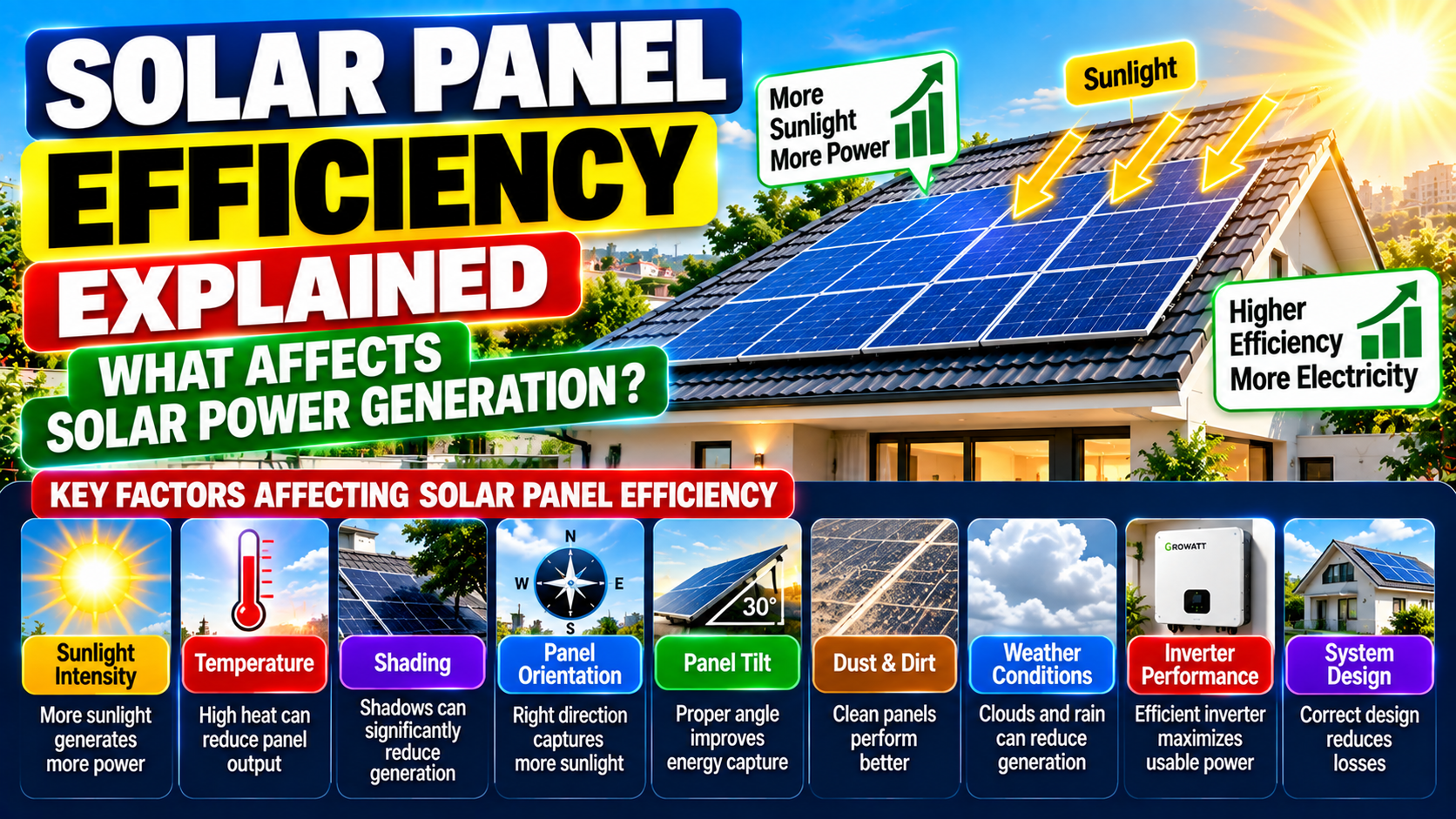
Solar panels convert sunlight into electricity, but the amount of electricity generated by a rooftop solar system can vary throughout the day and across different seasons.
When comparing solar panels, you may see specifications such as module efficiency, rated power and power output. These specifications are useful, but real-world solar generation also depends on the installation environment and system design.
A panel's performance can be influenced by sunlight intensity, temperature, shading, orientation, dust, ventilation, electrical losses and other conditions.
Understanding these factors can help homeowners make more informed decisions when planning a rooftop solar system.
What Is Solar Panel Efficiency?
Solar panel efficiency describes how effectively a solar module converts available solar energy into electrical energy under specified test conditions.
For example, a module may have an efficiency rating expressed as a percentage.
A higher efficiency percentage generally means that the module can produce more rated electrical power from a given amount of incident solar energy under the relevant test conditions.
However, panel efficiency should not be confused with the total electricity a complete rooftop system will generate.
System generation also depends on the installation and operating environment.
Why Is Solar Panel Efficiency Important?
Efficiency can become especially important when available roof space is limited.
Suppose two solar modules have similar physical dimensions but different rated power.
The higher-output module may allow a homeowner to install more total capacity within the available roof area.
This can be useful for:
- Small rooftops
- Urban homes
- Rooftops with many obstacles
- Commercial properties with limited usable space
- Projects requiring higher capacity from a restricted installation area
How Is Solar Panel Efficiency Calculated?
At a simplified level, solar module efficiency is related to the electrical power produced by the module compared with the solar energy falling on its surface under specified test conditions.
The calculation can be represented as:
Efficiency = Electrical Power Output ÷ Solar Energy Input × 100
The manufacturer's stated efficiency should be interpreted using the applicable test conditions and technical documentation.
What Factors Affect Solar Panel Power Generation?
Solar generation is influenced by several factors.
The major ones include:
- Sunlight intensity
- Temperature
- Shading
- Panel orientation
- Panel tilt
- Dust and dirt
- Weather conditions
- Roof conditions
- Electrical losses
- Inverter performance
- System design
- Equipment condition
Let's examine them individually.
1. Sunlight Intensity
Solar panels require sunlight to generate electricity.
When solar irradiance is stronger, the available energy reaching the module is generally higher.
Generation can vary throughout the day:
Morning → Increasing Generation
Midday → Potentially Higher Generation
Afternoon → Changing Generation
Evening → Declining Generation
The exact generation pattern depends on location, season, weather and system orientation.
2. Temperature
Solar panels operate outdoors and can become hot under strong sunlight.
Temperature affects the electrical characteristics of photovoltaic modules.
Manufacturers provide temperature coefficients in their datasheets to describe how module performance changes with temperature.
This means a panel's rated output under standard test conditions should not be interpreted as its guaranteed output under every outdoor temperature.
3. Shading
Shading is one of the important factors that can affect rooftop solar generation.
Potential sources include:
- Trees
- Buildings
- Water tanks
- Parapet walls
- Chimneys
- Nearby structures
- Other rooftop equipment
Even a relatively small shaded area can affect a solar array depending on its electrical configuration.
A proper site survey should therefore identify potential shading throughout the relevant parts of the day.
4. Panel Orientation
The direction in which solar panels are installed affects how sunlight reaches the module.
The appropriate orientation depends on:
- Geographic location
- Roof direction
- Available roof area
- Shading
- Structural conditions
- System design
Panels should be positioned according to the site's solar conditions rather than using a fixed arrangement without assessment.
5. Panel Tilt
Panel inclination can also influence solar energy capture.
The appropriate tilt depends on the property's location and installation conditions.
A rooftop system should balance:
- Solar exposure
- Roof geometry
- Structural requirements
- Wind considerations
- Maintenance access
- Available space
The mathematically ideal tilt is not always practical for every roof.
6. Dust and Dirt
Solar modules are installed outdoors and can accumulate:
- Dust
- Dirt
- Bird droppings
- Leaves
- Other surface deposits
A layer of dirt can reduce the amount of sunlight reaching the photovoltaic cells.
The effect varies depending on:
- Local environment
- Rainfall
- Dust levels
- Panel angle
- Nearby construction
- Surrounding vegetation
Cleaning should follow the module manufacturer's recommendations.
7. Weather Conditions
Solar generation naturally changes with weather.
Cloudy conditions can reduce solar irradiance reaching the modules.
Other environmental factors can also affect generation.
Therefore, daily generation should not be expected to remain constant throughout the year.
A more meaningful assessment looks at generation over longer periods.
8. Panel Temperature and Ventilation
Solar modules are exposed to outdoor temperatures and direct sunlight.
The physical installation can influence airflow around the panels.
A suitable mounting arrangement can provide space between the module and roof surface where the installation design permits.
The manufacturer's installation instructions should always be followed.
9. Electrical Losses
Not all electricity generated by the solar modules reaches the final electrical load.
Losses can occur in different parts of the system, including:
- DC cables
- Connectors
- Inverter conversion
- AC cables
- Electrical equipment
A professional system design aims to keep avoidable losses within appropriate limits.
10. Inverter Performance
The solar inverter converts DC electricity from the solar modules into AC electricity.
Its performance can therefore affect the amount of usable electricity delivered by the system.
When selecting an inverter, consider:
- Rated capacity
- Conversion efficiency
- MPPT configuration
- Maximum DC input
- Voltage range
- Current limits
- Operating conditions
The inverter should be compatible with the selected solar modules and system configuration.
11. Solar Panel Age
Solar modules are designed for long-term operation.
However, their electrical output can gradually change over time.
Manufacturers may specify expected degradation and applicable performance terms in their product documentation.
This is different from sudden equipment failure.
The expected performance of a specific module should be evaluated using its manufacturer's documentation.
12. System Design
Two solar systems using the same panels can potentially produce different results if their designs differ.
Factors include:
- Number of modules
- String configuration
- Inverter selection
- Panel orientation
- Tilt
- Shading
- Cable design
- Roof layout
- Monitoring
- Installation quality
Therefore, panel efficiency alone does not determine the performance of the entire solar system.
What Is the Difference Between Panel Efficiency and System Efficiency?
These terms describe different things.
Panel Efficiency
Refers to the performance of an individual solar module under specified test conditions.
System Performance
Refers more broadly to how the complete solar installation generates and delivers electricity.
The complete system can include:
Solar Panels → DC Wiring → Inverter → AC Wiring → Electrical Loads
Losses and operating conditions can affect the electricity available at the end of this chain.
Does a Higher-Wattage Panel Always Mean More Generation?
Not necessarily.
A higher-rated panel can provide more power per module under specified test conditions, but the complete system still depends on:
- Number of panels
- Roof area
- Shading
- Orientation
- Temperature
- Inverter
- System design
For example, a high-wattage module installed on a heavily shaded roof may not perform as expected.
Does a Larger Solar System Always Produce More Electricity?
A larger installed capacity generally provides greater generation potential, but actual production depends on the site and operating conditions.
Adding more panels does not automatically solve:
- Severe shading
- Poor orientation
- Incorrect system design
- Inadequate inverter configuration
- Excessive electrical losses
System quality matters alongside installed capacity.
How Can You Improve Solar System Performance?
Homeowners can focus on several practical areas.
Keep Panels Relatively Clean
Follow the manufacturer's cleaning recommendations and local maintenance requirements.
Avoid Unnecessary Shading
Consider trees and rooftop structures when planning the installation.
Use Appropriate Equipment
Panels and inverters should be compatible and correctly sized.
Monitor Generation
Regular monitoring can help identify unusual changes in system output.
Maintain Electrical Equipment
Follow recommended inspection and maintenance procedures.
Review the Installation Layout
The panel arrangement should account for orientation, tilt, shading and available roof space.
How Can Solar Generation Be Monitored?
Many modern solar systems provide monitoring through an inverter display, monitoring portal or mobile application.
Depending on the equipment, you may be able to see:
- Current generation
- Daily generation
- Monthly generation
- Historical generation
- System status
- Error notifications
- Other performance information
Monitoring can help identify unexpected changes.
For example, if a system normally produces a certain pattern but suddenly shows a significant unexplained reduction, the homeowner can ask the installer to investigate.
What Should You Do If Solar Generation Suddenly Drops?
First check whether there is an obvious environmental reason.
Possible causes include:
- Cloudy weather
- Heavy rain
- Temporary shading
- Dust accumulation
- Inverter alerts
- Grid-related conditions
- Electrical faults
- Equipment issues
Do not immediately assume that the solar panels have failed.
Review the monitoring information and contact an appropriately qualified installer or service provider when necessary.
Solar Panel Efficiency vs Solar Generation
These concepts are related but not identical.
| Factor | What It Describes |
|---|---|
| Panel Efficiency | How effectively a module converts solar energy under specified conditions |
| Rated Power | Electrical output rating of the module |
| Solar Generation | Electricity actually produced by the system |
| System Losses | Energy lost between generation and usable output |
| Performance | Overall operation of the complete installation |
A high-efficiency module can be useful, but the complete system design remains important.
Common Solar Efficiency Mistakes
Mistake 1: Assuming Rated Wattage Is Constant
A panel's rated wattage is measured under specified test conditions.
Mistake 2: Ignoring Shading
Shading can significantly affect generation depending on the system configuration.
Mistake 3: Assuming More Panels Always Solve the Problem
System design and site conditions matter.
Mistake 4: Ignoring Temperature
Module output characteristics change with temperature.
Mistake 5: Never Monitoring Generation
Without monitoring, unusual performance changes may go unnoticed.
Mistake 6: Comparing Panels Only by Efficiency
Price, dimensions, wattage, electrical specifications, compatibility and installation conditions should also be considered.
Solar Panel Performance Checklist
Before installing a rooftop solar system, check:
- ✅ Solar module efficiency
- ✅ Rated power
- ✅ Roof orientation
- ✅ Roof tilt
- ✅ Shading
- ✅ Available roof area
- ✅ Panel dimensions
- ✅ Inverter compatibility
- ✅ DC/AC electrical design
- ✅ Cable routing
- ✅ Monitoring system
- ✅ Maintenance requirements
- ✅ Local environmental conditions
Frequently Asked Questions
What is solar panel efficiency?
Solar panel efficiency indicates how effectively a solar module converts incident solar energy into electrical power under specified test conditions.
Does higher solar panel efficiency mean higher electricity production?
Higher efficiency can allow more rated power to be installed within a given area, but actual electricity generation also depends on sunlight, temperature, shading, orientation, system design and other factors.
Does heat reduce solar panel output?
Temperature affects the electrical characteristics of solar modules. The exact effect can be evaluated using the manufacturer's temperature coefficients.
Does dust reduce solar panel generation?
Surface dirt can reduce the sunlight reaching the photovoltaic cells. The effect depends on the amount and type of soiling and local conditions.
Does shading affect solar panels?
Yes. Shading can reduce generation, with the impact depending on the amount of shading and the electrical configuration of the solar array.
How can I improve rooftop solar performance?
A suitable system design, appropriate panel positioning, shading assessment, proper equipment selection, monitoring and manufacturer-recommended maintenance can help support system performance.
Can I calculate exact solar generation before installation?
Generation can be estimated using site-specific information, but actual output varies with weather, temperature, shading and other operating conditions.
Why does solar generation change from day to day?
Solar irradiance, cloud cover, temperature, shading, season and other environmental conditions change from day to day, so solar generation naturally varies.
Conclusion
Solar panel efficiency is an important specification, but it is only one part of a rooftop solar system's performance.
Actual electricity generation depends on a combination of:
Sunlight + Temperature + Orientation + Tilt + Shading + Panel Characteristics + Inverter + Electrical Design + Maintenance
For homeowners, the goal should not simply be to purchase the panel with the highest efficiency percentage. Instead, the complete system should be designed around the property's electricity requirements, available roof space and local conditions.
Before purchasing solar, ask the installer to explain the expected generation, system assumptions and factors that could affect performance.
Understanding these factors can help you compare solar proposals more effectively and plan a rooftop solar system around realistic expectations.
Found this useful?
Share this solar business article.