
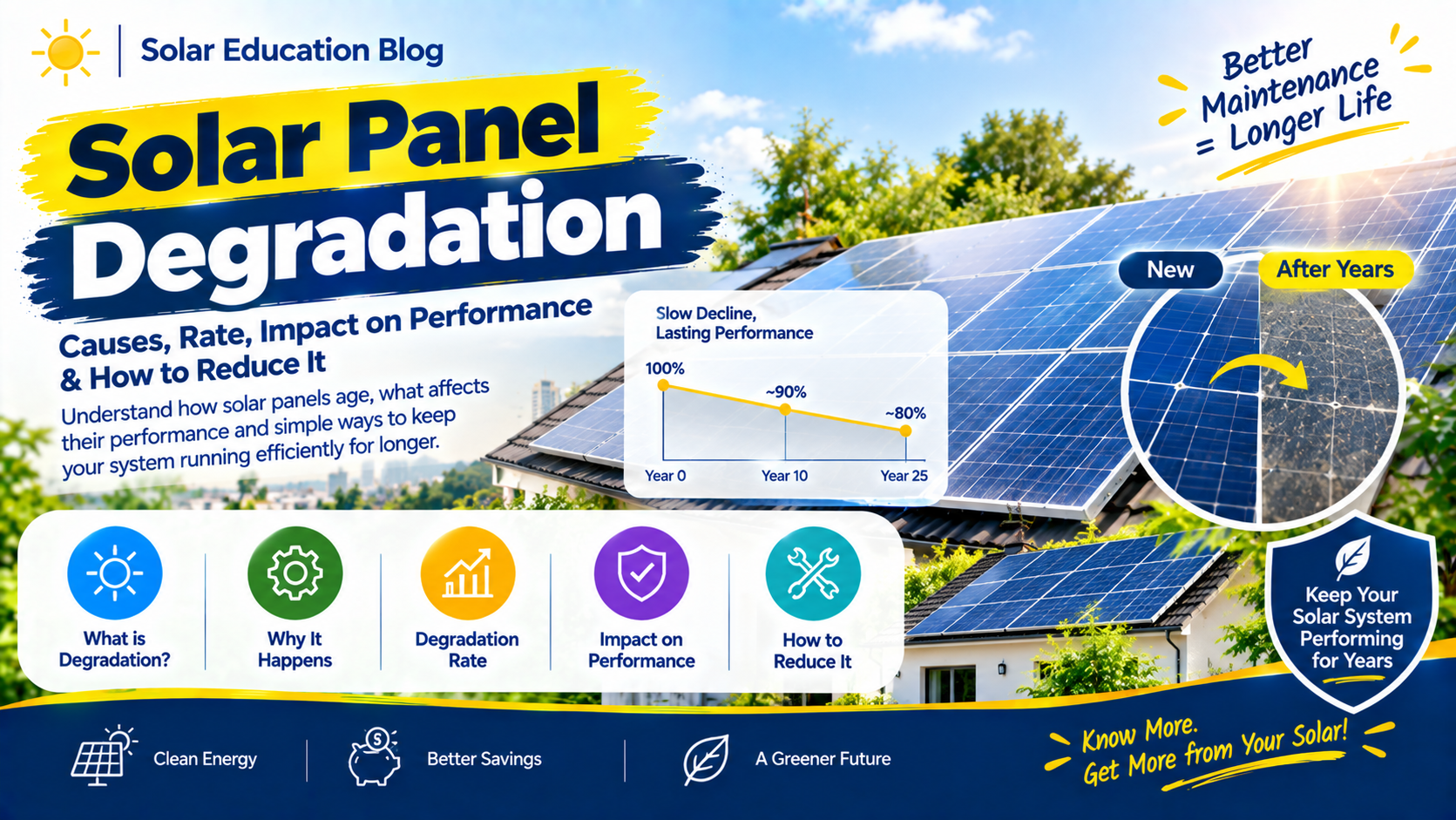
Solar panels are designed to generate electricity for many years, but their power output does not remain exactly the same throughout their operating life. Over time, solar modules can experience a gradual reduction in their ability to produce electricity. This process is known as solar panel degradation.
For homeowners and businesses investing in a rooftop solar system, understanding degradation is important because the system is a long-term investment. A panel that produces a certain amount of electricity when new may produce slightly less after several years.
The good news is that modern solar panels are designed to maintain a substantial portion of their original performance over their useful life.
This guide explains what solar panel degradation is, why it happens, how quickly it occurs, who should be concerned about it, where degradation can happen, when it starts, and how to reduce performance losses.
What Is Solar Panel Degradation?
Solar panel degradation is the gradual reduction in a solar module's electricity-generating capacity over time.
For example, if a solar panel is rated to produce 500 watts under specified test conditions, its actual maximum output may gradually decline as the module ages.
Degradation does not mean that a solar panel suddenly stops working.
Instead, it is generally a slow, progressive reduction in power output.
Simple Example
Suppose a solar panel initially produces:
500 W
After years of operation, its maximum output might be somewhat lower because of natural aging.
The actual degradation rate depends on factors such as:
- Solar panel technology
- Manufacturing quality
- Environmental conditions
- Temperature
- Humidity
- UV exposure
- Installation quality
- Mechanical stress
- Maintenance
- Operating conditions
This is why the degradation specification and performance warranty should be considered when purchasing solar panels.
Why Do Solar Panels Degrade?
Solar panels operate outdoors throughout the year. They are exposed to sunlight, heat, rain, humidity, dust, wind and temperature changes.
Over many years, these conditions can gradually affect the materials inside a solar module.
Some important causes include:
1. UV Exposure
Solar modules receive continuous exposure to ultraviolet radiation.
Long-term UV exposure can contribute to aging of certain module materials, including encapsulants and protective layers.
2. Thermal Cycling
Solar panels heat up during the day and cool down at night.
This repeated expansion and contraction can create mechanical stress within the module.
Over many years, thermal cycling can contribute to:
- Microcracks
- Solder fatigue
- Interconnection stress
- Electrical resistance changes
3. Moisture and Humidity
Solar modules are designed to resist outdoor moisture, but prolonged exposure to humidity can contribute to material aging if moisture protection is compromised.
Potential issues can include:
- Corrosion
- Insulation deterioration
- Electrical connection problems
- Encapsulant degradation
4. Mechanical Stress
Strong winds, improper handling, heavy snow in some regions, installation problems and other mechanical stresses can potentially damage modules.
Incorrect installation practices can increase the risk of long-term module problems.
5. Microcracks
Microcracks are small cracks that can develop in solar cells.
They may result from manufacturing, transportation, installation or long-term environmental stress.
Not every microcrack immediately causes a major performance problem, but certain cracks can affect the electrical pathways within a solar module.
6. Potential-Induced Degradation
Certain electrical and environmental conditions can contribute to forms of degradation commonly discussed in the solar industry, including potential-induced degradation (PID).
Modern module designs and system components can incorporate measures intended to reduce such risks, but system design and component compatibility remain important.
How Fast Do Solar Panels Degrade?
There is no single degradation rate that applies to every solar panel.
The rate depends on:
- Panel technology
- Manufacturer
- Cell design
- Environmental conditions
- Installation quality
- Climate
- Operating conditions
Many modern solar panels are designed with long-term performance warranties that specify the expected minimum power output after a defined period.
Therefore, instead of relying only on a general industry average, buyers should check the specific manufacturer's datasheet and performance warranty.
What Is a Solar Panel Performance Warranty?
A solar panel performance warranty is different from a product warranty.
Product Warranty
A product warranty generally relates to defects or problems associated with the module itself.
Depending on the manufacturer and product, coverage may address manufacturing or material defects for a specified period.
Performance Warranty
A performance warranty specifies the expected minimum power output of the module over time.
For example, a manufacturer may guarantee that the panel will retain a specified percentage of its original rated power after a certain number of years.
The exact terms vary between products.
Always read the warranty document for the specific solar panel model you are purchasing.
Solar Panel Degradation vs Solar Panel Damage
These two terms should not be confused.
| Solar Panel Degradation | Solar Panel Damage |
|---|---|
| Usually gradual | Can happen suddenly |
| Related to aging | Can result from physical or electrical events |
| Expected over the module's life | May be unexpected |
| Usually measured as declining output | May cause significant localized or total loss |
| Covered through performance specifications in some cases | May be covered under product warranty depending on cause |
A sudden reduction in electricity generation should not automatically be considered normal degradation.
It may indicate another issue.
What Can Cause a Sudden Drop in Solar Generation?
If your solar system suddenly produces significantly less electricity, possible causes include:
- Heavy dust accumulation
- Partial shading
- Failed inverter
- Loose electrical connection
- Damaged solar module
- Faulty string
- Grid-related issues
- Monitoring problems
- Protection-device operation
- Cable damage
- Severe weather
- Temporary system shutdown
A gradual reduction over many years may be consistent with normal aging, but a sudden drop deserves investigation.
Does Solar Panel Degradation Reduce Your Savings?
Yes, reduced solar generation can eventually affect the amount of electricity your system offsets.
However, the financial impact depends on several factors.
These include:
- Electricity consumption
- Electricity tariff
- Solar system size
- Annual solar generation
- Panel degradation rate
- Net-metering or applicable billing arrangement
- Self-consumption
- Maintenance
- System downtime
For example, if a rooftop system initially generates a certain amount of electricity each year, gradual degradation may cause generation to decrease over the long term.
That is one reason it is useful to consider the long-term performance specification, rather than comparing panels only by their initial wattage.
What Factors Affect Solar Panel Degradation?
Several factors can influence long-term solar module performance.
1. Panel Quality
Manufacturing quality and material selection can affect long-term reliability.
When comparing products, look at:
- Datasheet specifications
- Product warranty
- Performance warranty
- Manufacturer documentation
- Module technology
- Certifications
- Installation requirements
2. Climate
Solar panels installed in hot, humid, dusty or harsh environments may experience different operating conditions from panels installed in mild climates.
Temperature, humidity, UV exposure and environmental contamination can all influence long-term performance.
3. Installation Quality
A high-quality solar panel can still experience problems if the system is poorly installed.
Professional installation should consider:
- Structural support
- Correct mounting
- Cable management
- Electrical protection
- Earthing
- Ventilation
- Waterproofing
- Correct connector handling
4. Maintenance
Regular inspection can help identify problems before they become major issues.
Maintenance may include:
- Visual inspection
- Solar panel cleaning when necessary
- Inverter inspection
- Monitoring generation
- Checking electrical connections
- Inspecting cables
- Checking mounting structures
- Reviewing system alerts
How Can You Reduce Solar Panel Performance Loss?
You cannot completely eliminate natural aging, but proper system design, installation and maintenance can help protect long-term performance.
Keep Panels Clean
Dust, dirt, bird droppings and other deposits can reduce sunlight reaching the solar cells.
Clean panels when environmental conditions make cleaning necessary.
Reduce Avoidable Shading
Check for new shading caused by:
- Growing trees
- New buildings
- Water tanks
- Antennas
- Other rooftop structures
Monitor Solar Generation
Regularly monitor your system's electricity production.
A significant unexplained change can provide an early indication of a problem.
Use Professional Installation
Correct installation can help reduce mechanical, electrical and waterproofing problems.
Follow Manufacturer Guidelines
Use the manufacturer's installation, operation and maintenance instructions for the specific module and inverter.
How Can You Check If Your Solar Panels Are Losing Performance?
There are several ways to monitor long-term performance.
Method 1: Check Inverter Data
Many modern solar inverters provide information such as:
- Daily generation
- Monthly generation
- Annual generation
- Current power
- System alerts
- Historical performance
Method 2: Compare Generation Over Similar Conditions
Comparing electricity production from similar periods can be useful.
For example, compare:
June 2025 vs June 2026
But remember that weather conditions, sunlight hours, temperature, dust and shading can differ significantly between years.
Method 3: Check Your Electricity Meter
For grid-connected systems, electricity-meter data can help you understand how much energy is being exported or imported.
However, meter readings alone may not provide a complete picture of solar-panel performance.
Method 4: Professional Inspection
If production appears consistently lower than expected, a qualified solar professional can inspect the system.
Depending on the problem, testing may include:
- Module inspection
- String testing
- Inverter diagnostics
- Electrical testing
- Thermal inspection
- Connector inspection
When Should You Worry About Solar Panel Degradation?
Normal gradual aging is expected.
You should investigate the system if you notice:
- A sudden generation drop
- Repeated inverter errors
- One section producing substantially less energy
- Visible module damage
- Hot spots
- Broken glass
- Burn marks
- Loose cables
- Water ingress
- Unexpected system shutdowns
A sudden performance problem should not simply be attributed to panel degradation.
Who Should Pay Attention to Solar Panel Degradation?
Solar degradation is particularly relevant for:
Homeowners
People installing rooftop solar for long-term electricity savings should understand expected panel performance over the system's life.
Businesses
Commercial solar installations often involve larger investments, making long-term system performance an important financial consideration.
Solar Buyers
Anyone comparing solar modules should examine both initial efficiency and long-term performance specifications.
Solar Installers
Installers should consider module quality, system design, environmental conditions and installation practices when designing a rooftop solar system.
Where Does Solar Panel Degradation Happen?
Degradation can affect different parts or materials of a solar module.
Potentially affected areas include:
- Solar cells
- Encapsulant materials
- Electrical connections
- Backsheet or protective layers
- Junction box
- Interconnects
The exact failure mechanism depends on the module construction, environmental exposure and operating conditions.
Solar Panel Degradation: Important Buying Checklist
Before purchasing solar panels, ask the installer or manufacturer for:
- Panel model number
- Rated power
- Module efficiency
- Product warranty
- Performance warranty
- Specified degradation terms
- Datasheet
- Installation requirements
- Applicable certifications
- Warranty claim procedure
- Authorized service information
- Recommended maintenance requirements
Do not compare solar panels only by their price per watt.
Long-term reliability, warranty terms, system compatibility and installation quality also matter.
Solar Panel Degradation and Rooftop Solar Investment
A rooftop solar system is generally intended to operate for many years.
Therefore, the initial purchase price is only one part of the investment.
A more complete evaluation should consider:
Initial system cost + installation quality + electricity generation + maintenance + warranty + long-term performance
A panel with a strong long-term performance specification may be worth evaluating alongside its initial price, but the right choice depends on the specific product, system design, location and financial objectives.
5 Practical Tips to Maintain Long-Term Solar Performance
Tip 1: Monitor Your System
Check generation regularly instead of waiting for a major problem.
Tip 2: Keep Panels Reasonably Clean
Remove excessive dirt and deposits when required.
Tip 3: Watch for New Shading
Trees and rooftop structures can change shading conditions over time.
Tip 4: Keep Warranty Documents
Store your invoices, module serial numbers, datasheets, warranties and installation documents.
Tip 5: Investigate Unexpected Changes
A sudden drop in generation should be checked rather than assumed to be normal degradation.
Frequently Asked Questions About Solar Panel Degradation
1. What is solar panel degradation?
Solar panel degradation is the gradual reduction in a solar module's ability to generate electricity as it ages.
2. Do solar panels stop working after their warranty period?
No. A warranty period does not necessarily mean the solar panel stops working when the warranty ends. Panels can continue generating electricity beyond the warranty period, although their output may gradually decline.
3. How long do solar panels last?
Solar panels are designed for long-term operation, but actual service life and performance depend on the specific module, installation, environment and maintenance. Check the manufacturer's warranty and technical documentation for the exact product.
4. Can solar panel degradation be stopped?
Natural aging cannot be completely stopped. However, proper installation, suitable system design, cleaning when required, monitoring and maintenance can help reduce avoidable performance losses.
5. Does heat reduce solar panel performance?
Yes. Solar modules generally produce less power at higher operating temperatures than under standard test conditions. Temperature effects are different from long-term degradation, although heat exposure can also contribute to aging over many years.
6. Does cleaning solar panels prevent degradation?
Cleaning does not stop natural module aging. However, removing excessive dirt and other deposits can help maintain the panel's available generation when soiling is affecting performance.
7. What is the difference between product warranty and performance warranty?
A product warranty generally addresses defects in materials or workmanship, while a performance warranty specifies the expected power-output performance of the module over a defined period.
8. Why has my solar generation suddenly dropped?
Possible causes include shading, dirt, inverter problems, electrical faults, damaged panels, grid issues or monitoring problems. A sudden drop should be investigated rather than automatically attributed to normal degradation.
9. Should I compare solar panels based only on wattage?
No. Compare wattage together with efficiency, warranty terms, degradation specifications, technology, certifications, installation requirements and overall system compatibility.
10. Is solar panel degradation important when buying a rooftop solar system?
Yes. Because rooftop solar is a long-term investment, understanding expected long-term performance can help you compare different solar modules and evaluate their potential value over time.
Conclusion
Solar panel degradation is a normal part of long-term solar module operation. The key is understanding the difference between expected gradual aging and unexpected system performance problems.
When buying a rooftop solar system, look beyond the initial price. Review the panel's technical specifications, product warranty, performance warranty and long-term performance information. After installation, monitor electricity generation, maintain the system properly and investigate unusual changes in performance.
With appropriate system design, quality installation and regular monitoring, a rooftop solar system can continue generating useful clean electricity for many years.
Found this useful?
Share this solar business article.