
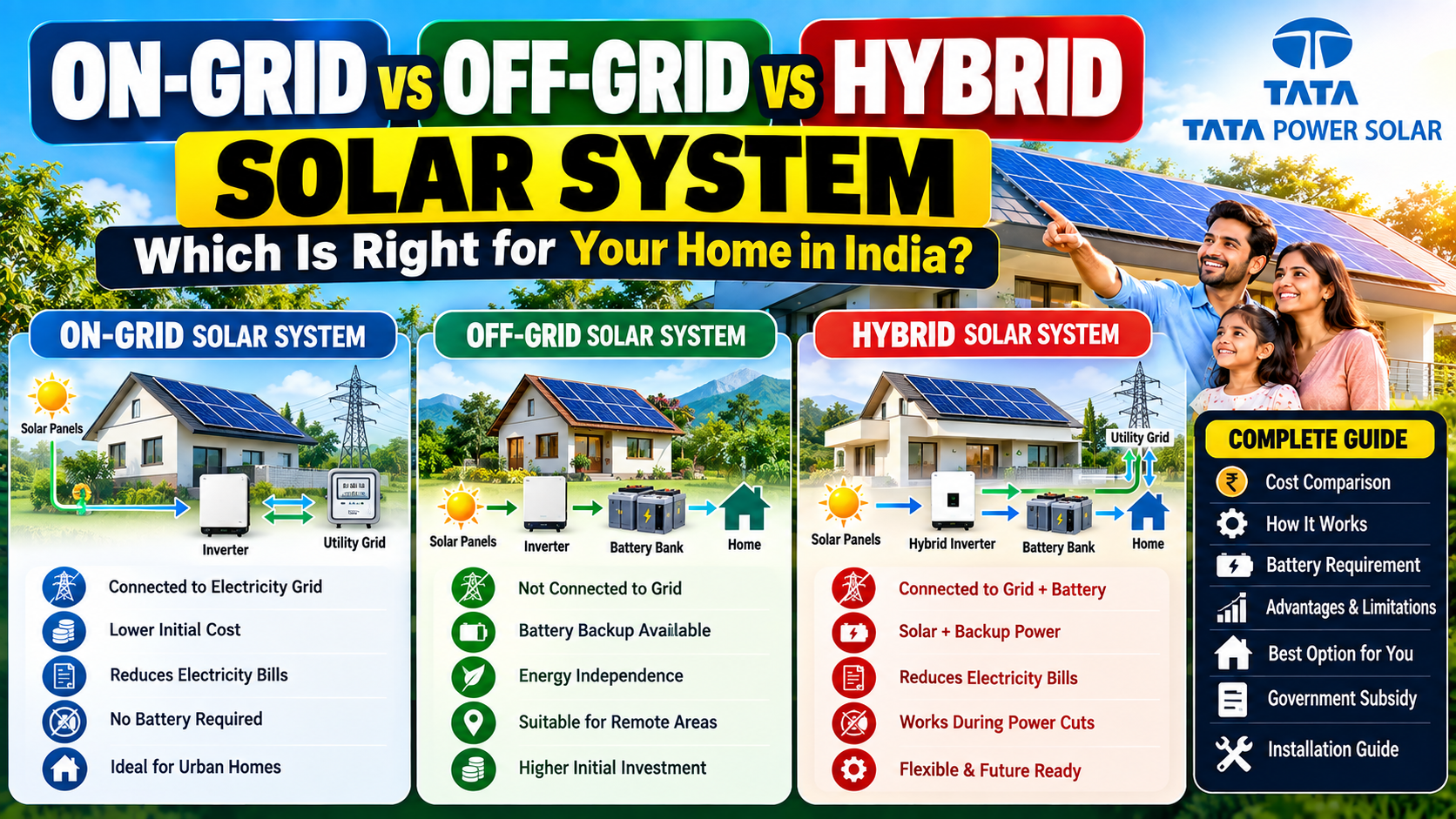
Solar energy is becoming an increasingly important option for Indian homeowners looking to generate electricity from their rooftops and reduce their dependence on conventional electricity.
However, choosing a solar system is not always straightforward. Homeowners commonly come across three options: on-grid solar, off-grid solar and hybrid solar systems.
Although all three systems use solar panels to generate electricity, their working methods, battery requirements, grid connectivity, backup capabilities and overall system design are different.
In this guide, we explain the difference between on-grid vs off-grid vs hybrid solar systems, how they work, their advantages and limitations, battery requirements, and the factors homeowners should consider before installing rooftop solar in India.
What Is an On-Grid Solar System?
An on-grid solar system, also known as a grid-connected solar system, is connected to the electricity grid.
Solar panels generate electricity during the day. This electricity can be used by household appliances. When solar generation is higher than the home's immediate consumption, eligible surplus electricity may be exported to the electricity grid under the applicable regulations and approved metering arrangement.
When solar generation is insufficient, electricity can be supplied from the grid.
How On-Grid Solar Works
The basic energy flow is:
Sunlight → Solar Panels → Solar Inverter → Home Appliances
When there is surplus generation:
Solar Panels → Inverter → Electricity Grid
When solar generation is insufficient:
Electricity Grid → Home
An on-grid system can therefore be suitable for homes that already have a reliable electricity connection and primarily want to reduce their electricity purchases.
Advantages of On-Grid Solar
Lower Initial Investment
A standard on-grid solar system generally does not require a large battery bank. This can make its initial investment lower than a comparable battery-based system.
Reduced Electricity Bills
Solar generation can reduce the amount of electricity purchased from the grid. Actual savings depend on electricity consumption, tariff structure, system capacity, solar generation and applicable regulations.
No Battery Replacement
A conventional on-grid system without batteries does not have battery replacement requirements.
Suitable for Urban Homes
On-grid rooftop solar can be considered by homeowners in cities and towns where grid electricity is readily available.
Important Limitation of On-Grid Solar
One of the most important things to understand is that a standard on-grid solar system generally does not provide electricity during a grid power outage.
This is because grid-connected inverters normally shut down when the electricity grid goes offline, which is an important safety requirement.
Therefore:
On-grid solar should not automatically be considered a backup-power system.
If backup electricity during power cuts is important, homeowners should discuss a suitable battery-based or hybrid solution with a qualified installer.
What Is an Off-Grid Solar System?
An off-grid solar system is designed to operate independently of the electricity grid.
Instead of relying on the utility grid, the system uses solar panels and batteries to generate and store electricity.
A typical off-grid system can include:
Solar panels
Solar inverter
Battery bank
Mounting structure
DC and AC cables
Protection equipment
Earthing system
Monitoring equipment
How Off-Grid Solar Works
During the day:
Solar Panels → Inverter → Home + Battery Charging
During periods without solar generation:
Battery → Inverter → Home Appliances
The battery stores energy generated during the day so that it can be used later.
Where Is Off-Grid Solar Useful?
Off-grid solar can be useful in locations where electricity-grid connectivity is unavailable, limited or unreliable.
Potential applications include:
Remote homes
Farmhouses
Agricultural properties
Rural locations
Remote offices
Construction locations
Areas with limited electricity infrastructure
The system needs to be properly sized according to electricity consumption and the required battery backup duration.
Advantages of Off-Grid Solar
Energy Independence
An off-grid system can operate without depending on the utility electricity grid.
Battery Backup
Stored electricity can be used when solar generation is unavailable.
Suitable for Remote Areas
Off-grid solar can provide electricity in locations where connecting to the grid is difficult or impractical.
Limitations of Off-Grid Solar
The main consideration is the battery system.
Batteries can increase the overall system cost and require proper installation, management and eventual replacement.
The solar panels and battery bank must also be correctly sized.
An undersized system may not provide enough electricity during periods of high consumption, cloudy weather or extended periods of low solar generation.
What Is a Hybrid Solar System?
A hybrid solar system combines solar panels, battery storage and grid connectivity.
It can provide the benefits of grid-connected solar while also allowing battery storage for backup or energy management.
A simplified energy flow is:
Solar Panels → Hybrid Inverter → Home
Solar can also charge the battery:
Solar → Battery
The grid can also supply or receive electricity depending on the system configuration and applicable regulations.
How Does a Hybrid Solar System Work?
During the day, solar panels generate electricity.
The electricity can be used for household appliances, used to charge the battery or, where permitted, surplus electricity can be exported to the grid.
During a power outage, a properly designed hybrid system can provide electricity to selected backup loads using battery energy.
The exact backup capability depends on:
Hybrid inverter
Battery capacity
Electrical wiring
Backup-load configuration
System design
Installer configuration
On-Grid vs Off-Grid vs Hybrid Solar
| Feature | On-Grid Solar | Off-Grid Solar | Hybrid Solar |
|---|---|---|---|
| Grid Connection | Yes | No | Yes |
| Solar Panels | Yes | Yes | Yes |
| Battery | Usually not required | Required | Usually included |
| Power Backup | Normally no | Yes | Yes, when configured |
| Electricity Bill Reduction | Yes | Yes | Yes |
| Remote Location | Limited suitability | Suitable | Depends on requirements |
| Initial Investment | Generally lower | Generally higher | Generally higher |
| Battery Maintenance | Not applicable without battery | Required | Required |
| Grid Dependence | Yes | No | Reduced |
| Main Purpose | Solar + grid | Independent power | Solar + grid + backup |
Which Solar System Should You Choose?
There is no single solar system that is ideal for every household.
Your choice should depend on electricity consumption, grid availability, power-cut frequency, budget, rooftop space and backup requirements.
On-Grid Solar May Suit You If:
Your home has a reliable electricity connection.
Your primary objective is reducing electricity bills.
You do not require battery backup.
You want a comparatively simple solar installation.
You want to avoid the additional cost of a battery system.
Off-Grid Solar May Suit You If:
Your property has no reliable grid connection.
You need independent electricity generation.
You are located in a remote area.
Battery storage is an essential requirement.
You want the system to operate independently of the grid.
Hybrid Solar May Suit You If:
You want solar power and battery backup.
Your area experiences frequent power cuts.
You want to remain connected to the electricity grid.
You want greater flexibility between solar, battery and grid electricity.
Backup power is an important requirement.
How Much Solar Capacity Does a Home Need?
Solar system size should not be selected simply according to the size of the house.
Important factors include:
Monthly electricity consumption
Average electricity bill
Available rooftop area
Roof orientation
Shading
Local solar conditions
Household appliances
Future electricity consumption
Desired backup duration
Battery requirements
A professional site assessment can help determine an appropriate system size.
Does Solar Work During Monsoon?
Yes, solar panels can generate electricity during cloudy and rainy weather, but generation generally decreases when sunlight intensity is lower.
Solar generation can vary because of:
Cloud cover
Rain
Shading
Panel orientation
Panel cleanliness
Temperature
Installation design
For this reason, solar performance should be evaluated over longer periods rather than expecting identical generation every day.
Can Solar Panels Generate Electricity at Night?
Solar panels require sunlight to generate electricity, so they do not directly generate electricity at night.
Depending on the system configuration, a home can use:
Grid electricity
Stored battery electricity
A combination of battery and grid electricity
This is one of the major differences between on-grid, off-grid and hybrid solar systems.
What Is a Solar Inverter?
Solar panels generate electricity in DC form, while most household appliances use AC electricity.
The solar inverter converts and manages the electricity so it can be used by household appliances or transferred according to the system design.
Depending on the inverter type, it can also manage:
Grid synchronization
Battery charging
Battery discharge
Load management
System monitoring
Protection functions
The inverter is therefore an important component of a rooftop solar system.
What Is Net Metering?
Net metering is an electricity billing arrangement available under applicable regulations.
In an approved grid-connected rooftop solar system, surplus eligible electricity generated by the solar installation can be exported to the electricity grid through an approved meter arrangement.
The rules can differ by state and electricity distribution company.
Therefore, homeowners should check the latest requirements applicable to their electricity connection before calculating expected savings.
Solar Subsidy in India
Government support and incentives for residential rooftop solar can affect the effective cost of an eligible solar installation.
However, subsidy eligibility, capacity limits, approved vendors, application procedures and other requirements can change over time.
Homeowners should therefore verify the latest information from the relevant official government and electricity-distribution authorities before making a purchase decision.
Avoid relying on outdated subsidy figures published in old articles or social media posts.
Tata Power Solar for Residential Rooftop Solar
Tata Power Solar is associated with Tata Power's solar energy business and offers solar solutions for different applications.
Homeowners considering a Tata Power Solar solution should evaluate the specific system proposed for their property, including:
Solar panel specifications
System capacity
Inverter configuration
Installation scope
Warranty
Service support
Applicable approvals
Applicable government incentives
Customers should verify current product specifications, pricing, availability and applicable offers through authorized channels before purchasing.
How to Choose a Solar Installer?
Before finalizing a solar installation, ask for a detailed quotation.
The quotation should clearly mention:
Solar panel manufacturer and model
Panel wattage
Number of panels
Inverter manufacturer and model
Inverter capacity
Mounting structure
DC cables
AC cables
Protection equipment
Earthing
Installation charges
Monitoring system
Battery specifications, if applicable
Warranty terms
Expected annual generation
Applicable approvals
Applicable subsidy information
Comparing complete technical proposals is more useful than comparing only the advertised price.
Questions to Ask Before Installing Solar
What Solar Capacity Do I Need?
The installer should calculate system capacity according to your electricity consumption, roof area and site conditions.
Will Solar Work During a Power Cut?
Ask specifically whether the proposed system provides backup power and which appliances can operate during an outage.
Do I Need Batteries?
If power backup is important, battery storage may need to be included.
Is My Roof Suitable?
The installer should evaluate usable roof area, shading, orientation and installation conditions.
What Is Included in the Price?
Confirm whether installation, mounting structure, wiring, protection equipment, approvals and other services are included.
What Are the Warranty Terms?
Ask separately about warranties for solar panels, inverters, batteries and other major components.
How Much Electricity Will the System Generate?
Ask for an estimated annual generation based on the actual installation location and system specifications.
Frequently Asked Questions
Is on-grid solar better than off-grid solar?
They are designed for different requirements. On-grid systems are designed around a grid connection, while off-grid systems are designed to operate independently using battery storage.
Which solar system works during a power cut?
A standard on-grid system generally does not provide backup during a grid outage. Properly configured off-grid and hybrid systems can provide backup using battery storage.
Does a hybrid solar system require a battery?
Hybrid systems generally use battery storage, but the exact configuration depends on the inverter and system design.
Which solar system is suitable for a city home?
For a home with a reliable grid connection, homeowners commonly consider grid-connected rooftop solar. If backup is also required, a hybrid system can be evaluated.
Can solar panels work during cloudy weather?
Yes. Solar panels can still generate electricity under cloudy conditions, although output can be lower than under strong sunlight.
Can batteries be added later?
This depends on the inverter and system architecture. If future battery backup is important, it should be discussed before selecting the inverter.
Conclusion
Understanding the difference between on-grid, off-grid and hybrid solar systems is an important step before installing rooftop solar.
On-grid solar focuses on solar generation alongside the electricity grid.
Off-grid solar is designed for independent electricity generation with battery storage.
Hybrid solar combines solar generation, grid connectivity and battery storage to provide additional flexibility and backup capability.
The appropriate system depends on your electricity consumption, rooftop conditions, grid availability, power-cut frequency, budget and backup requirements.
Before making a purchase, get a proper site assessment and compare detailed quotations covering the complete system, expected generation, warranties, installation scope and applicable approvals.
A solar installation is a long-term investment, so the system should be selected according to your actual energy requirements rather than simply choosing the lowest advertised price.
Found this useful?
Share this solar business article.