
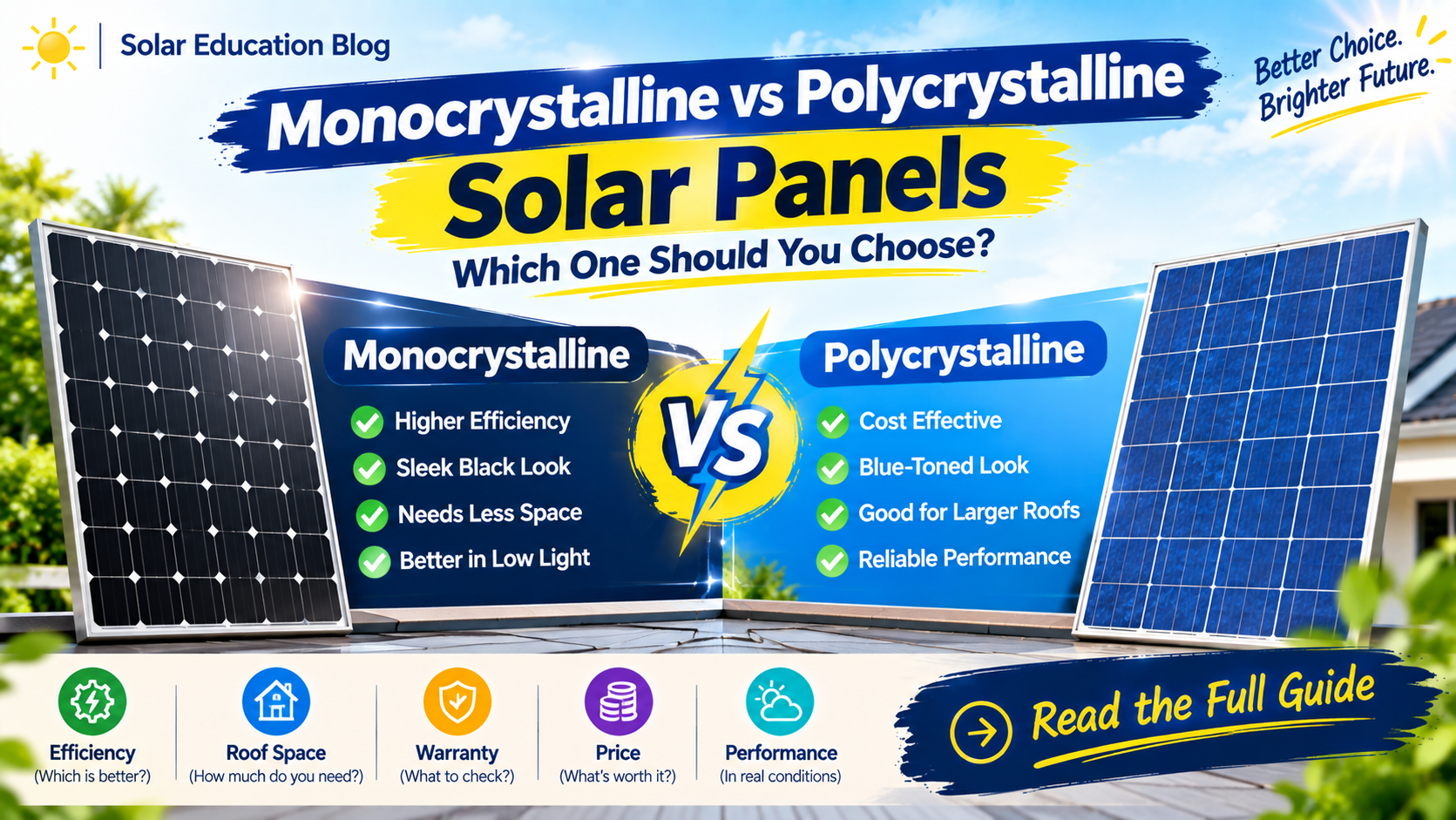
Choosing the right solar panels is one of the most important decisions when installing a rooftop solar system. Two commonly discussed solar panel technologies are monocrystalline and polycrystalline panels.
Although both convert sunlight into electricity, they differ in cell construction, appearance, efficiency characteristics, space requirements and other specifications.
This guide explains the key differences between monocrystalline vs polycrystalline solar panels so homeowners and businesses can make an informed comparison.
What Are Monocrystalline Solar Panels?
Monocrystalline solar panels are made using solar cells manufactured from crystalline silicon with a single-crystal structure.
They are commonly recognizable by their dark or black appearance, although the exact appearance can vary by module design.
Monocrystalline panels are widely used in residential and commercial rooftop installations.
Key Features
- High power output options are available
- Generally higher efficiency than traditional polycrystalline modules
- Useful where roof space is limited
- Typically have a uniform appearance
- Available in many modern module designs
What Are Polycrystalline Solar Panels?
Polycrystalline solar panels are also based on silicon solar cells, but the manufacturing process uses multiple silicon crystal structures.
They commonly have a blue-toned appearance, although appearance varies by manufacturer and module design.
Polycrystalline technology has historically been popular because of its manufacturing characteristics and cost considerations.
Key Features
- Silicon-based technology
- Typically blue-toned appearance
- Traditionally lower efficiency than monocrystalline modules
- Can be suitable where sufficient roof space is available
- Available in a range of power ratings
Monocrystalline vs Polycrystalline: Key Differences
| Feature | Monocrystalline | Polycrystalline |
|---|---|---|
| Cell structure | Single-crystal silicon structure | Multiple-crystal silicon structure |
| Typical appearance | Dark/black | Blue-toned |
| Efficiency | Generally higher | Generally lower than mono modules |
| Roof space | More suitable when space is limited | May require more area for the same system capacity |
| Technology | Crystalline silicon | Crystalline silicon |
| Residential use | Common | Historically common |
| Selection factors | Efficiency, space, power, warranty and price | Space, power, warranty and price |
Exact specifications vary by manufacturer and module model.
Which Solar Panel Is More Efficient?
In general, monocrystalline panels have higher efficiency than traditional polycrystalline panels.
However, efficiency should not be considered in isolation.
For a rooftop system, you should also compare:
- Rated power
- Panel dimensions
- Warranty
- Temperature characteristics
- Degradation specifications
- Inverter compatibility
- Installation conditions
- Total system cost
A panel with a higher efficiency rating can be particularly useful when the available roof area is limited.
Why Does Panel Efficiency Matter?
Solar panel efficiency indicates how effectively a panel converts available sunlight into electricity under specified test conditions.
Higher efficiency can allow more electrical capacity to be installed within a given roof area.
For example, if two panels produce similar power but one requires less physical space, the more space-efficient option may be useful for a smaller rooftop.
However, actual electricity generation depends on much more than the efficiency rating.
Monocrystalline Solar Panels: Advantages
1. Higher Efficiency
Monocrystalline modules generally offer higher efficiency than traditional polycrystalline modules.
2. Better Use of Limited Roof Space
Higher-efficiency modules can help maximize available roof area.
3. Modern Module Designs
Many newer monocrystalline modules use advanced cell and module technologies designed to provide high power output.
4. Suitable for Residential Rooftops
Their combination of power density and efficiency makes them a common choice for residential solar applications.
Monocrystalline Solar Panels: Considerations
Before choosing monocrystalline panels, consider:
- Purchase price
- Roof size
- Required system capacity
- Panel dimensions
- Warranty terms
- Manufacturer specifications
- Installation costs
A higher efficiency rating does not automatically mean the overall system will be the right choice for every property.
Polycrystalline Solar Panels: Advantages
1. Established Technology
Polycrystalline technology has been used extensively in solar installations.
2. Suitable Where Roof Space Is Available
If a property has sufficient usable roof area, the space requirement may be less of a concern.
3. Different Price and Product Options
The total cost depends on the specific panel, manufacturer, system capacity and installation requirements.
Polycrystalline Solar Panels: Considerations
Polycrystalline panels generally have lower efficiency than newer high-efficiency monocrystalline products.
This means that achieving the same installed capacity may require more panel area, depending on the specific modules being compared.
Which Panel Is Better for a Small Roof?
For a property with limited usable roof space, higher-efficiency panels can be advantageous because they can provide greater power capacity within a smaller area.
This makes monocrystalline panels an option worth considering for compact rooftops.
However, the final selection should be based on the complete system design rather than panel efficiency alone.
Which Panel Is Better for a Large Roof?
If a property has plenty of usable roof space, there may be greater flexibility in panel selection.
The comparison should then focus on:
- Total system cost
- Required capacity
- Panel availability
- Warranty
- Performance specifications
- Installer recommendations
- Long-term service support
Do Monocrystalline Panels Produce More Electricity?
A panel's electricity production depends on its rated power, sunlight availability, orientation, shading, temperature, system design and other factors.
Monocrystalline panels generally offer higher efficiency, which can help achieve more power from a given amount of area.
But the total electricity generated by a rooftop system depends on the entire installation, not just the panel type.
Do Solar Panels Work on Cloudy Days?
Solar panels can generate electricity under cloudy conditions because sunlight still reaches the modules, although generation can be lower than during strong direct sunlight.
Actual output depends on:
- Cloud cover
- Weather conditions
- Time of day
- Panel orientation
- Panel technology
- System configuration
What Should You Check Before Buying Solar Panels?
Before selecting a panel, review the manufacturer's technical datasheet.
Important specifications include:
Panel Power
Check the rated power output of each module.
Efficiency
Compare module efficiency when roof space is important.
Dimensions
Make sure the panels can fit properly on the available roof area.
Warranty
Review product and performance warranty terms carefully.
Temperature Characteristics
Check the module's temperature-related specifications.
Mechanical Specifications
Consider the panel's mechanical and environmental ratings according to the installation location.
Manufacturer Support
Check the availability of installation, warranty and after-sales support.
Common Mistakes When Choosing Solar Panels
Mistake 1: Choosing Only by Price
The cheapest panel is not necessarily the most suitable option.
Mistake 2: Looking Only at Efficiency
Efficiency is important, but it should be evaluated alongside power rating, dimensions, warranty and system design.
Mistake 3: Ignoring Roof Space
Panel dimensions should be checked before finalizing the system.
Mistake 4: Ignoring Shading
Even high-efficiency panels can experience reduced generation when significant shading affects the system.
Mistake 5: Not Checking Warranty Terms
Always understand what the warranty covers and how performance guarantees are defined.
Mistake 6: Selecting Panels Without Considering the Inverter
Panel and inverter compatibility is an important part of proper system design.
Monocrystalline vs Polycrystalline: Quick Decision Guide
Consider monocrystalline panels when:
- Roof space is limited
- Higher efficiency is important
- You want high power density
- You are comparing modern high-efficiency modules
Consider polycrystalline panels when:
- Adequate roof space is available
- The specific product meets your technical requirements
- Cost and overall system economics are important
- The available module suits your installation requirements
The final decision should be based on the specific products and system quotation, not simply the technology name.
Frequently Asked Questions
Are monocrystalline panels better than polycrystalline panels?
They have different characteristics. Monocrystalline panels generally offer higher efficiency, while the suitability of either technology depends on roof space, system requirements, cost, warranty and product specifications.
Which solar panel is best for a home?
The appropriate panel depends on your electricity consumption, roof area, shading, system capacity, budget and other technical requirements.
Do monocrystalline panels last longer?
Lifespan depends on the specific product, manufacturing quality, installation conditions and environmental exposure. Review the manufacturer's product and performance warranties.
Are polycrystalline panels still used?
Yes, polycrystalline technology remains a type of crystalline-silicon solar technology, although the product landscape has evolved and many current high-efficiency modules use newer monocrystalline-based designs.
Do monocrystalline panels work better in heat?
Panel performance under temperature changes depends on the module's specifications. Check the manufacturer's temperature coefficient rather than assuming one technology will always perform better.
Can I mix monocrystalline and polycrystalline panels?
It may be technically possible in certain system designs, but compatibility, electrical characteristics, inverter configuration and string design need to be evaluated by a qualified solar professional.
Solar Panel Buying Checklist
Before placing your order, check:
- Panel manufacturer
- Model number
- Rated power
- Efficiency
- Panel dimensions
- Product warranty
- Performance warranty
- Degradation terms
- Temperature specifications
- Inverter compatibility
- Installation requirements
- After-sales support
Conclusion
Monocrystalline and polycrystalline solar panels both use crystalline silicon technology, but they differ in their construction and typical performance characteristics.
Monocrystalline panels generally provide higher efficiency and can be particularly useful when roof space is limited. Polycrystalline panels may still be considered where sufficient roof space is available and the specific product meets the project's technical and economic requirements.
Instead of choosing a panel based on one feature, compare the complete solar solution—including panels, inverter, installation, warranty, roof space and expected energy requirements.
Found this useful?
Share this solar business article.