
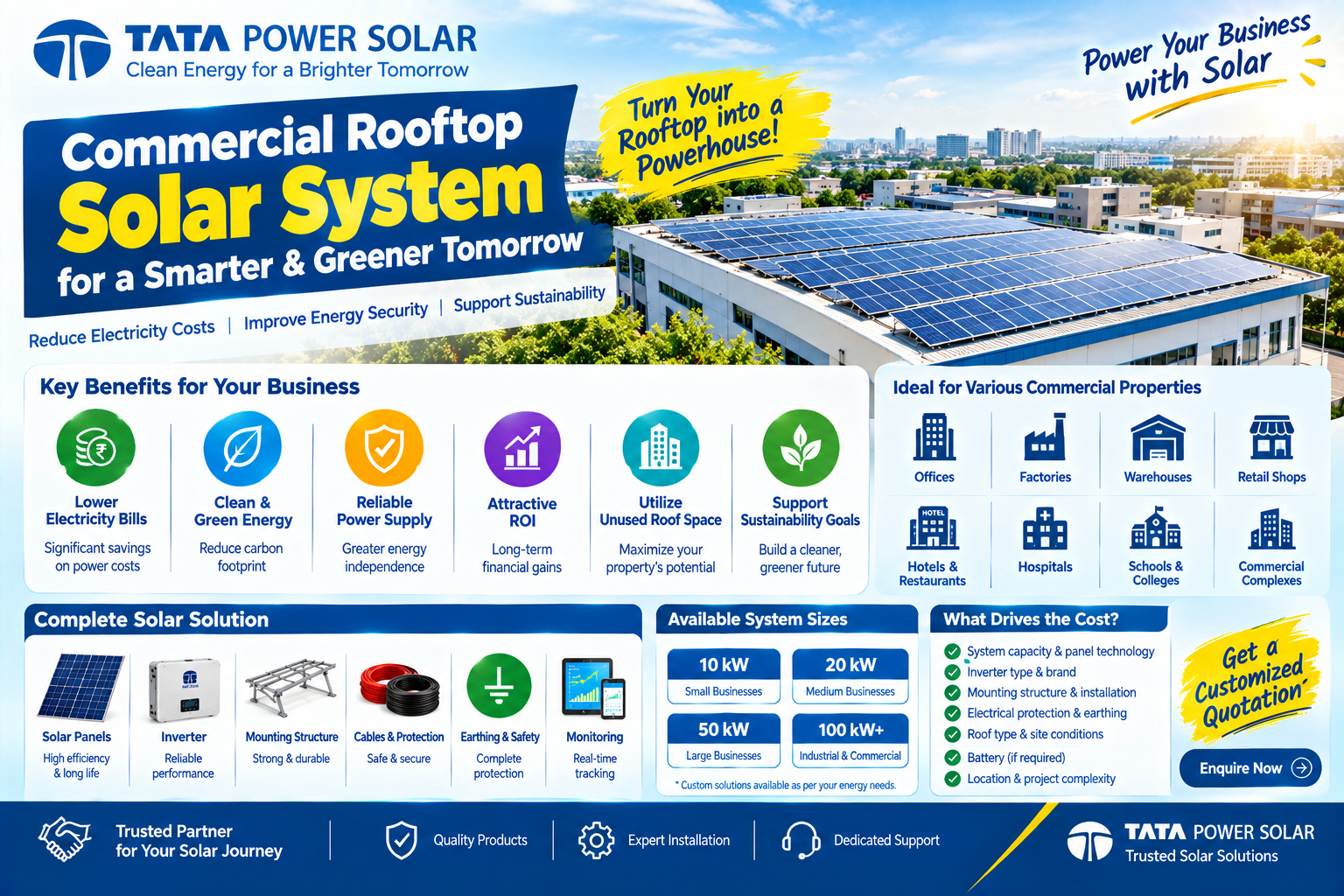
Electricity is one of the major operating expenses for many businesses in India. Shops, offices, hospitals, schools, warehouses, hotels, factories and commercial buildings often consume significant amounts of electricity during the day—the same period when a rooftop solar system can generate power.
A commercial rooftop solar system allows businesses to use available roof space to generate electricity from sunlight and reduce dependence on grid electricity. Depending on the system design and local electricity regulations, businesses can use the generated power directly and may also have options related to surplus electricity.
This guide explains what commercial rooftop solar is, why businesses install it, who can benefit, where it can be installed, when businesses should consider it, and how the system works.
What Is a Commercial Rooftop Solar System?
A commercial rooftop solar system is a solar power installation designed for businesses and commercial properties.
The system generally includes:
- Solar PV modules
- Solar inverter
- Mounting structures
- DC and AC cables
- Protection devices
- Earthing and lightning protection
- Monitoring equipment
- Electrical distribution equipment
- Optional battery storage
Solar panels convert sunlight into DC electricity. The inverter converts this electricity into usable AC electricity for the property's electrical loads.
For many commercial properties, an on-grid solar system is suitable when the objective is to reduce daytime electricity consumption from the grid. Businesses that require backup power may consider a hybrid solar system with battery storage.
Why Should Businesses Consider Rooftop Solar?
1. Reduce Electricity Expenses
One of the primary reasons businesses consider rooftop solar is to reduce the amount of electricity they need to purchase from the grid.
A properly sized system can generate a significant portion of a property's daytime electricity requirement.
2. Use Available Rooftop Space
Large commercial buildings often have unused rooftop areas.
Instead of leaving the roof unused, businesses can convert it into an electricity-generating asset.
3. Improve Energy Cost Planning
Grid electricity costs can change over time. Generating part of your electricity through solar can help businesses reduce their exposure to conventional electricity costs.
4. Support Sustainability Goals
Solar energy produces electricity without fuel combustion during operation. Businesses can use rooftop solar as part of their broader sustainability and energy-efficiency initiatives.
5. Suitable for Different Business Types
Commercial solar can be considered by:
- Retail shops
- Offices
- Warehouses
- Factories
- Hotels
- Hospitals
- Schools and colleges
- Restaurants
- Showrooms
- Apartment and commercial complexes
- Small and medium-sized businesses
Who Can Install a Commercial Solar System?
Almost any business with suitable electricity consumption, available roof space and appropriate technical conditions can investigate rooftop solar.
However, the ideal system size depends on several factors, including:
- Monthly electricity consumption
- Daytime electricity usage
- Available rooftop area
- Roof structure
- Electricity connection
- Local regulations
- Desired investment
- Future electricity requirements
A business should not select a solar capacity simply because a particular system size is popular. The system should be designed around the property's actual energy consumption.
How Does a Commercial Rooftop Solar System Work?
The basic process is straightforward:
Sunlight → Solar Panels → DC Electricity → Solar Inverter → AC Electricity → Business Loads
During daylight hours, solar panels generate electricity.
The inverter converts the electricity into AC power that can be used by the property's electrical equipment.
For an on-grid system, electricity can be consumed by loads such as:
- Computers
- Air conditioners
- Refrigerators
- Machines
- Pumps
- Lighting
- Elevators
- Production equipment
- Office equipment
If the solar system generates less electricity than the business is consuming, the remaining requirement can be supplied through the grid.
If generation exceeds the property's instantaneous requirement, the treatment of surplus electricity depends on the applicable electricity regulations and the connection arrangement.
How Much Solar Capacity Does a Business Need?
There is no universal solar capacity for every commercial property.
For example, a small office may require a much smaller system than a manufacturing facility.
A practical sizing process should consider:
Step 1: Check Electricity Bills
Review at least several months of electricity bills to understand:
- Monthly units consumed
- Demand or connected load
- Tariff structure
- Daytime consumption
- Seasonal variations
Step 2: Analyse Daytime Loads
Solar generation occurs during daylight hours, so daytime consumption is particularly important for an on-grid commercial system.
Step 3: Check Roof Area
The available roof should be inspected for:
- Usable area
- Shadow-free space
- Structural strength
- Roof orientation
- Roof condition
- Access for maintenance
Step 4: Select the System Capacity
The final capacity should be determined through a technical and financial assessment rather than electricity consumption alone.
What Is the Cost of a Commercial Rooftop Solar System?
There is no single price applicable to every commercial solar installation.
The final project cost can depend on:
- Solar panel technology
- Solar system capacity
- Inverter brand and configuration
- Mounting structure
- Roof type
- Cable length
- Electrical upgrades
- Installation complexity
- Monitoring requirements
- Battery storage
- Safety equipment
- Location
- Applicable taxes and project conditions
A commercial solar quotation should therefore be evaluated as a complete system proposal, rather than comparing only the price of solar panels.
On-Grid vs Hybrid Solar for Businesses
On-Grid Solar
An on-grid system operates alongside the electricity grid.
It can be suitable for businesses that:
- Have significant daytime electricity consumption
- Want to reduce grid electricity consumption
- Do not require solar-based backup for every load
- Have a suitable grid connection
Hybrid Solar
A hybrid system combines solar generation with battery storage and grid electricity.
It can be considered when a business requires:
- Backup power
- Energy storage
- Greater control over energy usage
- Support for selected critical loads
The additional battery equipment increases system complexity and cost, so the battery requirement should be evaluated based on actual backup needs.
What Is the ROI of Commercial Solar?
The return on investment depends on the relationship between the project's total cost and the value of electricity generated or avoided.
A simplified calculation is:
Annual Solar Savings = Solar Electricity Used or Offset × Applicable Electricity Cost
And:
Simple Payback Period = Total Project Cost ÷ Annual Savings
However, actual financial analysis should also consider:
- Electricity tariff
- Solar generation
- System degradation
- Maintenance costs
- Financing costs
- Taxes
- Regulatory arrangements
- Changes in electricity prices
- System downtime
- Future energy consumption
A professional solar feasibility assessment can provide a more realistic project estimate.
Where Can Commercial Solar Panels Be Installed?
Commercial solar systems can be installed on different types of roofs, including:
- RCC roofs
- Metal roofs
- Industrial sheds
- Warehouse roofs
- Commercial building roofs
- Factory rooftops
- Institutional buildings
Ground-mounted installations may also be considered when sufficient land is available.
Before installation, the roof should be assessed for structural suitability and long-term durability.
When Should a Business Consider Solar?
A business should consider evaluating rooftop solar when it has:
- High or increasing electricity expenses
- Significant daytime electricity consumption
- Suitable rooftop space
- Long-term occupancy of the property
- A suitable electricity connection
- An interest in controlling energy costs
- Sustainability objectives
Businesses planning a new facility can also consider solar during the building and electrical design stage.
Commercial Solar Installation Process
A typical project can involve these stages:
1. Electricity Bill Analysis
The installer reviews electricity consumption and tariff information.
2. Site Survey
The roof, electrical infrastructure, shading and installation conditions are assessed.
3. System Design
Solar capacity, panel arrangement, inverter configuration and electrical design are prepared.
4. Commercial Proposal
The business receives a quotation covering equipment, installation and other applicable project costs.
5. Approvals and Documentation
Required utility and regulatory processes are completed according to the applicable rules.
6. Installation
Solar modules, structures, inverter, wiring and safety equipment are installed.
7. Testing and Commissioning
The system is tested before being placed into operation.
8. Monitoring and Maintenance
Generation can be monitored through suitable inverter or energy-monitoring systems, while periodic maintenance helps maintain reliable performance.
Important Things to Check Before Buying Commercial Solar
Before signing a solar contract, businesses should check:
- Solar panel specifications
- Inverter specifications
- Product warranties
- Performance warranty terms
- Installation warranty
- Mounting structure quality
- Earthing and lightning protection
- Surge protection
- Monitoring system
- Installation timeline
- Maintenance responsibilities
- Service support
- Applicable approvals
- Payment terms
- Detailed project scope
Avoid comparing quotations only on the basis of total price.
A lower initial quotation may not represent the same equipment, engineering scope or after-sales support as another proposal.
Common Mistakes Businesses Should Avoid
Choosing Capacity Without Analysing Consumption
Solar capacity should be based on electricity usage, roof availability and project objectives.
Ignoring Roof Condition
A solar installation can remain on a roof for many years. Roof repairs should be considered before installation.
Focusing Only on Panel Price
Panels are only one component of a complete solar power system.
Ignoring Safety Equipment
Earthing, surge protection, lightning protection and proper electrical protection are important parts of a professional installation.
Not Comparing Complete Quotations
Businesses should compare equipment, warranties, installation scope, monitoring and service—not just the final price.
FAQs About Commercial Rooftop Solar
1. What is a commercial rooftop solar system?
It is a solar PV system installed on a commercial property's roof to generate electricity for business operations.
2. Can a factory install rooftop solar?
Yes. Factories with suitable roofs, electricity consumption and technical conditions can evaluate rooftop solar.
3. Is on-grid solar suitable for businesses?
On-grid solar can be suitable for businesses with significant daytime electricity consumption and an appropriate grid connection.
4. Does commercial solar require batteries?
Not necessarily. An on-grid system can operate without batteries. Batteries become relevant when backup or energy storage is required.
5. How do I calculate the required solar capacity?
Start with electricity bills, analyse daytime consumption, inspect the available roof area and have the system professionally designed.
6. How long does a commercial solar system last?
Solar components have different useful lives and warranty periods. Solar modules are generally designed for long-term operation, while inverters and other electrical components may have different replacement timelines.
7. Can solar reduce a company's electricity bill?
Yes, solar generation can reduce the amount of electricity a business needs to purchase from the grid, subject to system design and applicable electricity arrangements.
8. What should I include in a commercial solar quotation?
The quotation should clearly specify panels, inverter, mounting structure, electrical equipment, protection systems, installation, commissioning, warranties, monitoring, maintenance and applicable approvals.
Conclusion
A commercial rooftop solar system can transform an unused rooftop into a long-term electricity-generation asset. For businesses with suitable daytime electricity consumption, solar can help reduce dependence on grid electricity while supporting broader energy and sustainability objectives.
The right solution depends on the property's electricity consumption, roof area, system capacity, equipment selection, local regulations and financial objectives.
Before investing, businesses should conduct a proper energy assessment, rooftop survey, technical design and financial analysis and compare complete quotations rather than focusing only on the initial system price.
Found this useful?
Share this solar business article.