
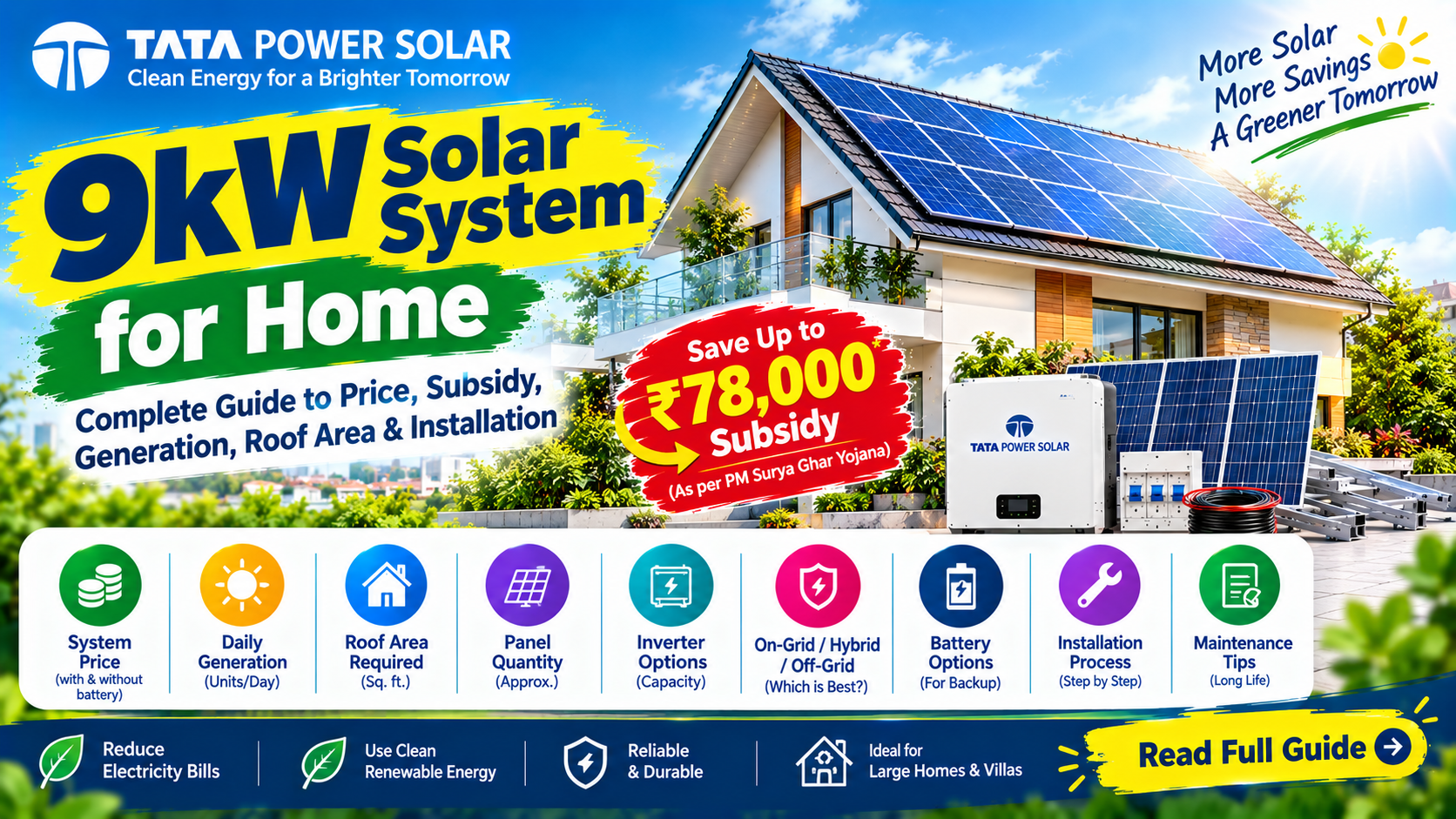
For homes with high electricity consumption, choosing the right solar capacity is an important decision. Multiple air conditioners, refrigerators, water heaters, pumps, appliances, home offices and electric vehicle charging can significantly increase monthly electricity usage.
A 9kW solar system is a high-capacity rooftop solar solution that can be considered for large homes, villas, bungalows and other properties with substantial electricity demand.
But installing a larger system is not simply a matter of buying more solar panels.
Before choosing a 9kW system, homeowners should evaluate electricity consumption, roof space, shading, inverter capacity, electrical connection, solar generation, battery requirements, applicable metering rules and future electricity demand.
This detailed guide explains what a 9kW solar system is, why you may need one, who should consider it, where it can be installed, when it makes sense and how to choose the right configuration.
What Is a 9kW Solar System?
A 9kW solar system is a rooftop photovoltaic system with approximately 9 kilowatts of installed solar capacity.
A typical residential system can include:
- Solar PV modules
- Solar inverter
- Mounting structure
- DC cables and connectors
- AC cables
- DC protection
- AC protection
- Earthing
- Surge protection
- Solar monitoring
- Metering-related equipment where applicable
- Battery storage for hybrid or off-grid configurations
The exact number of panels depends on the wattage of the selected modules.
Example 9kW Panel Configurations
| Panel Wattage | Approx. Number of Panels | Approx. Capacity |
|---|---|---|
| 400W | 23 | 9.20kW |
| 450W | 20 | 9.00kW |
| 540W | 17 | 9.18kW |
| 550W | 17 | 9.35kW |
| 600W | 15 | 9.00kW |
The final panel configuration should be designed according to the actual module specifications, inverter characteristics, roof layout and applicable electrical requirements.
Why Choose a 9kW Solar System?
A 9kW system may be considered when a property has high electricity consumption.
Potential applications include:
- Large independent homes
- Villas
- Bungalows
- Duplex homes
- Large 4BHK and 5BHK homes
- Homes with multiple AC units
- Homes with EV charging
- Properties with electric water heating
- Homes with high daytime electricity consumption
- Small offices or commercial premises, subject to applicable regulations
A 9kW system provides more potential solar generation than smaller 3kW, 5kW, 7kW or 8kW systems.
However, larger capacity does not automatically mean a better system.
The capacity should be matched with your electricity consumption and applicable electricity-connection requirements.
Who Should Consider a 9kW Solar System?
A 9kW system can be evaluated if your property has high or increasing electricity demand.
1. Large Homes
Large homes often have more appliances and higher electricity consumption.
2. Multiple Air Conditioners
If several AC units operate regularly, electricity usage can increase substantially, particularly during summer.
3. Electric Vehicle Charging
An EV can add significant electricity consumption to a household.
4. Electric Water Heating
Geysers and other electric heating equipment can increase energy requirements.
5. High Daytime Consumption
Solar generation occurs primarily during daylight hours. If you use significant electricity during the day, you may be able to directly consume more of your solar generation.
6. Future Electricity Requirements
Homeowners expecting additional loads, such as an EV, additional ACs or other electrical equipment, can include those future requirements when sizing the system.
How Much Electricity Does a 9kW Solar System Generate?
Actual solar generation depends on:
- Location
- Solar irradiation
- Weather
- Season
- Panel orientation
- Panel tilt
- Shading
- Module efficiency
- Inverter efficiency
- Temperature
- Dust
- Electrical losses
For basic planning, assuming approximately 3.5–5 equivalent peak-sun-hours per day:
9kW × 3.5–5 hours = approximately 31.5–45 kWh/day
This gives a broad planning estimate of approximately:
945–1,350 kWh per 30-day month
or roughly:
11,500–16,400 kWh per year
These figures are indicative planning estimates, not guaranteed generation.
Actual generation can differ significantly depending on location and system conditions.
Factors That Can Reduce Generation
- Roof shading
- Dust accumulation
- Poor orientation
- Incorrect tilt
- Module temperature
- Inverter losses
- Equipment faults
- Weather conditions
- System downtime
A professional site survey and generation assessment should be used when calculating expected annual production.
How Much Roof Area Is Required for 9kW Solar?
A larger solar system requires more usable roof space.
The actual requirement depends on:
- Panel wattage
- Panel dimensions
- Mounting arrangement
- Roof design
- Required walkways
- Setbacks
- Shading
- Maintenance access
- Equipment placement
As a general planning allowance, a 9kW rooftop system may require approximately 750–950 square feet of usable roof area.
This is an indicative range rather than a fixed requirement.
High-wattage panels may reduce the number of modules, while their physical dimensions and required installation spacing still need to be considered.
Check Your Roof Before Installation
Inspect:
- Total roof area
- Usable area
- Shadow-free area
- Roof strength
- Orientation
- Tilt
- Water drainage
- Nearby buildings
- Trees
- Water tanks
- Cable routes
- Maintenance access
9kW Solar System Price in India
There is no single fixed nationwide price for a 9kW solar system.
The total project cost depends on the equipment and installation scope.
Major Price Factors
- Solar panel technology
- Panel wattage
- Module manufacturer
- Solar inverter
- Inverter capacity
- Mounting structure
- Electrical protection
- Cable length
- Earthing
- Surge protection
- Roof height
- Installation complexity
- Monitoring
- Warranty
- Location
- Transportation
- Battery storage
An on-grid 9kW system will generally have a different cost structure from a 9kW hybrid system with battery storage.
What Should Be Included in the Quotation?
Ask the installer to clearly specify:
- Solar panel brand and model
- Panel wattage
- Number of panels
- Inverter brand and model
- Inverter capacity
- Mounting structure
- DC cables
- AC cables
- Protection equipment
- Earthing
- Surge protection
- Installation
- Monitoring
- Metering assistance, where applicable
- Warranty
- Taxes
- Battery specifications, if included
This makes it easier to compare different quotations accurately.
9kW Solar System Subsidy in India
Subsidy is one of the most searched topics when homeowners compare rooftop solar systems.
Under the published PM Surya Ghar: Muft Bijli Yojana residential CFA structure:
- First 2kW: ₹30,000/kW
- Additional 1kW: ₹18,000/kW
- Additional capacity beyond 3kW: No additional central CFA
Therefore, the published structure reaches a maximum central CFA of ₹78,000 for 3kW, rather than providing CFA calculated across the entire 9kW system.
The scheme's operational guidelines state an implementation period through 31 March 2027 for the PM Surya Ghar programme.
At the same time, the MNRE page for the older Grid Connected Rooftop Solar Programme lists its existing Phase-II period as ending on 31 March 2026.
Important
Because rooftop-solar implementation and portal procedures can change, homeowners should verify the current eligibility, application process and applicable CFA through the official PM Surya Ghar/MNRE and DISCOM channels before purchasing.
Do not assume that subsidy is calculated on all 9kW.
On-Grid vs Hybrid vs Off-Grid 9kW Solar System
The system type is another major decision.
9kW On-Grid Solar System
An on-grid system works together with the electricity grid.
Typical flow:
Solar Panels → Solar Inverter → Home Loads → Grid
During the day, solar electricity can supply household loads. Depending on the applicable metering arrangement, surplus electricity may be exported to the grid.
Suitable for:
- Homes with reliable grid electricity
- Customers primarily focused on reducing grid electricity consumption
- Properties that do not require extensive battery backup
9kW Hybrid Solar System
A hybrid system combines:
- Solar panels
- Hybrid inverter
- Battery
- Grid electricity
Typical flow:
Solar Panels → Hybrid Inverter → Home + Battery + Grid
The battery provides backup according to the inverter configuration, battery capacity and household load.
Suitable for:
- Homes with frequent power interruptions
- Customers who require backup
- Homes wanting solar energy storage
- Properties with critical electrical loads
Battery storage can significantly increase the overall system cost.
9kW Off-Grid Solar System
An off-grid system is designed to operate independently from the utility grid.
It generally requires:
- Solar panels
- Off-grid inverter
- Battery bank
- Appropriate protection
- Carefully planned electrical loads
Suitable for:
- Remote properties
- Areas without reliable grid supply
- Applications designed for energy independence
For an urban home with reliable electricity supply, an off-grid system may not be necessary.
What Components Are Required for a 9kW Solar System?
Solar Panels
Solar panels convert sunlight into DC electricity.
Solar Inverter
The inverter converts DC electricity into AC electricity that can be used by household appliances.
Mounting Structure
The mounting structure supports the panels and positions them appropriately.
DC Cables
These connect the solar modules to the inverter.
AC Cables
These connect the inverter to the home's electrical system.
DC and AC Protection
Depending on the system design, protection can include:
- DC isolators
- Fuses
- AC breakers
- Surge protection devices
Earthing
Proper earthing is an important component of electrical safety.
Monitoring
Monitoring can provide information such as:
- Daily generation
- Monthly generation
- Inverter status
- System alerts
- Historical performance
Battery
A battery is optional for many on-grid installations but becomes an important component of hybrid and off-grid systems.
How Is a 9kW Solar System Installed?
A professional installation generally follows these stages.
Step 1: Electricity Consumption Analysis
Review your electricity bills, preferably across several months, to understand your actual consumption.
Step 2: Site Survey
The installer evaluates:
- Roof area
- Shading
- Orientation
- Roof condition
- Electrical connection
- Cable routes
Step 3: Solar System Design
The installer determines:
- Panel quantity
- Panel configuration
- Inverter capacity
- String configuration
- Mounting structure
- Protection requirements
Step 4: Quotation
A complete quotation is prepared with equipment and installation details.
Step 5: Applicable Approvals
Where required, the relevant DISCOM and metering procedures are completed.
Step 6: Mounting Structure Installation
The structure is installed according to the approved design.
Step 7: Solar Panel Installation
The panels are mounted and connected.
Step 8: Inverter Installation
The inverter is installed at a suitable location with adequate ventilation and protection.
Step 9: Electrical Connections
AC, DC, earthing and protection systems are connected.
Step 10: Testing
The complete system is tested before commissioning.
Step 11: Monitoring Setup
The monitoring application or portal is configured where supported.
9kW Solar System for a Large Home
A 9kW system can be considered for larger properties, but the number of bedrooms alone should not determine system size.
For example, a 4BHK home may have:
- 2 ACs
- Limited daytime usage
- No EV
- Standard appliances
Another 4BHK home may have:
- 5 ACs
- Multiple geysers
- EV charging
- Water pumps
- High daytime electricity usage
The electricity requirements of these two homes can be very different.
Therefore, solar capacity should be based on electricity consumption rather than house size alone.
9kW Solar System for EV Charging
If you own an electric vehicle, its electricity consumption should be included when calculating your solar requirement.
Consider:
- Daily driving distance
- EV battery size
- Charging frequency
- Home charger capacity
- Charging schedule
- Existing home electricity consumption
If the EV is charged during solar-generation hours, some of the charging load may be directly supplied by solar depending on the system configuration.
If charging occurs primarily at night, grid electricity or battery storage may be required.
How Much Can a 9kW Solar System Save?
Savings depend on:
- Solar generation
- Electricity tariff
- Monthly consumption
- Daytime usage
- Self-consumption
- Export/metering arrangement
- System price
- Financing
- Maintenance
For this reason, there is no single guaranteed annual saving for every 9kW system.
A better approach is to calculate:
Expected Annual Solar Generation × Applicable Electricity Value = Potential Annual Energy Value
Then account for:
- Grid-export treatment
- Fixed charges
- Maintenance
- Financing
- Other applicable charges
A customized solar proposal should use your actual electricity bills to estimate potential savings.
9kW Solar System Maintenance
Solar panels have relatively low routine maintenance requirements, but regular checks are still important.
Monitor:
- Panel cleanliness
- Inverter status
- Daily generation
- Mounting structure
- Cables
- Earthing
- Protection equipment
- Shading
- System alarms
Watch for Changes in Generation
If your system suddenly produces less electricity than expected under similar sunlight conditions, possible causes include:
- Dust
- Shading
- Inverter problems
- Module problems
- Electrical faults
- Monitoring errors
- Weather
Regular monitoring helps identify unusual performance.
Common Mistakes When Buying a 9kW Solar System
1. Choosing Capacity Without Checking Bills
A 9kW system should be justified by electricity consumption and future demand.
2. Buying Only on Lowest Price
Two systems with the same capacity may have completely different equipment and installation quality.
3. Ignoring Inverter Specifications
The inverter should be appropriate for the planned solar array and electrical configuration.
4. Ignoring Shading
Trees, water tanks and nearby structures can affect solar production.
5. Assuming Subsidy Applies to 9kW
The published PM Surya Ghar residential CFA structure provides no additional central CFA beyond 3kW.
6. Buying Excessive Battery Capacity
Battery size should be based on actual backup requirements.
7. Ignoring Warranty Conditions
Review product warranties, performance warranties and installation warranties separately.
8. Comparing Incomplete Quotations
Always compare the complete scope of supply and installation.
9kW vs 8kW vs 10kW Solar System
| Feature | 8kW | 9kW | 10kW |
|---|---|---|---|
| Solar capacity | 8kW | 9kW | 10kW |
| Potential generation | Lower | Higher | Higher |
| Roof requirement | High | Higher | Higher |
| Initial investment | Lower | Higher | Higher |
| Suitable consumption | High | Higher | Very high |
| EV charging | Possible | Suitable for higher demand | Suitable for higher demand |
| Battery option | Yes | Yes | Yes |
The correct capacity depends on electricity consumption, roof availability and future loads.
W5H Guide to a 9kW Solar System
What is a 9kW solar system?
It is a rooftop solar photovoltaic system with approximately 9kW of installed capacity.
Why install a 9kW solar system?
It can provide greater potential solar generation for properties with relatively high electricity consumption.
Who should consider it?
Large homes, villas, bungalows and suitable properties with high electricity demand can evaluate a 9kW system.
Where can it be installed?
It can be installed on a suitable rooftop or engineered structure with sufficient sunlight, usable space and structural suitability.
When should you choose 9kW?
Consider it when your current and expected electricity consumption justifies a system larger than capacities such as 5kW, 7kW or 8kW.
How does it work?
Solar panels convert sunlight into DC electricity. The inverter converts the electricity into AC power for household loads. Depending on the system configuration, electricity can also be stored in batteries or exported to the grid under applicable rules.
Frequently Asked Questions
1. What is the price of a 9kW solar system in India?
There is no single fixed price. The total cost depends on panels, inverter, structure, protection, installation, location and whether battery storage is included.
2. How many panels are required for a 9kW solar system?
It depends on panel wattage. For example, 20 panels of 450W provide approximately 9kW, while 15 panels of 600W also provide approximately 9kW.
3. How much electricity does a 9kW solar system generate?
A rough planning estimate is approximately 31.5–45 kWh per day under suitable solar conditions. Actual generation varies according to location, season, shading, orientation and system losses.
4. How much roof area is required for 9kW solar?
A general planning allowance may be approximately 750–950 square feet, although actual requirements depend on panel dimensions and installation layout.
5. Does a 9kW solar system qualify for subsidy?
Under the published PM Surya Ghar residential CFA structure, central assistance applies through the first 3kW, with no additional central CFA beyond 3kW.
6. Can I install a 9kW system with batteries?
Yes. A suitable hybrid inverter and battery bank can be integrated into a 9kW solar system.
7. Is 9kW enough for a large house?
It may be suitable for some large homes, but actual electricity consumption should be analyzed before choosing the capacity.
8. Can a 9kW system eliminate my electricity bill?
It can significantly reduce grid electricity purchases in suitable circumstances, but a zero bill is not guaranteed.
9. Is a 9kW system suitable for EV charging?
It can be considered for homes with EV charging, but EV electricity consumption should be included in the system-sizing calculation.
10. Should I choose on-grid or hybrid?
An on-grid system focuses on grid-connected solar generation, while a hybrid system adds battery storage and backup capability.
11. What should I check before buying a 9kW solar system?
Check the panel model, panel wattage, inverter, mounting structure, electrical protection, cables, installation scope, warranties, monitoring, metering process and after-sales service.
Conclusion
A 9kW solar system can be considered for large homes and properties with high electricity consumption. It provides substantial solar-generation capacity and can be useful for properties with multiple ACs, high daytime electricity usage, electric water heating or EV charging.
However, the right system size should be determined from actual electricity consumption rather than house size alone.
Before purchasing, compare complete quotations that clearly specify:
- Solar panels
- Inverter
- Mounting structure
- Protection equipment
- Cables
- Earthing
- Installation
- Monitoring
- Warranty
- After-sales support
For subsidy planning, verify the latest applicable PM Surya Ghar and DISCOM procedures. The published residential CFA structure provides assistance through 3kW and no additional central CFA beyond 3kW.
A properly designed 9kW solar system should ultimately match your electricity consumption, roof area, future requirements, budget, backup needs and local electricity regulations.
Found this useful?
Share this solar business article.