
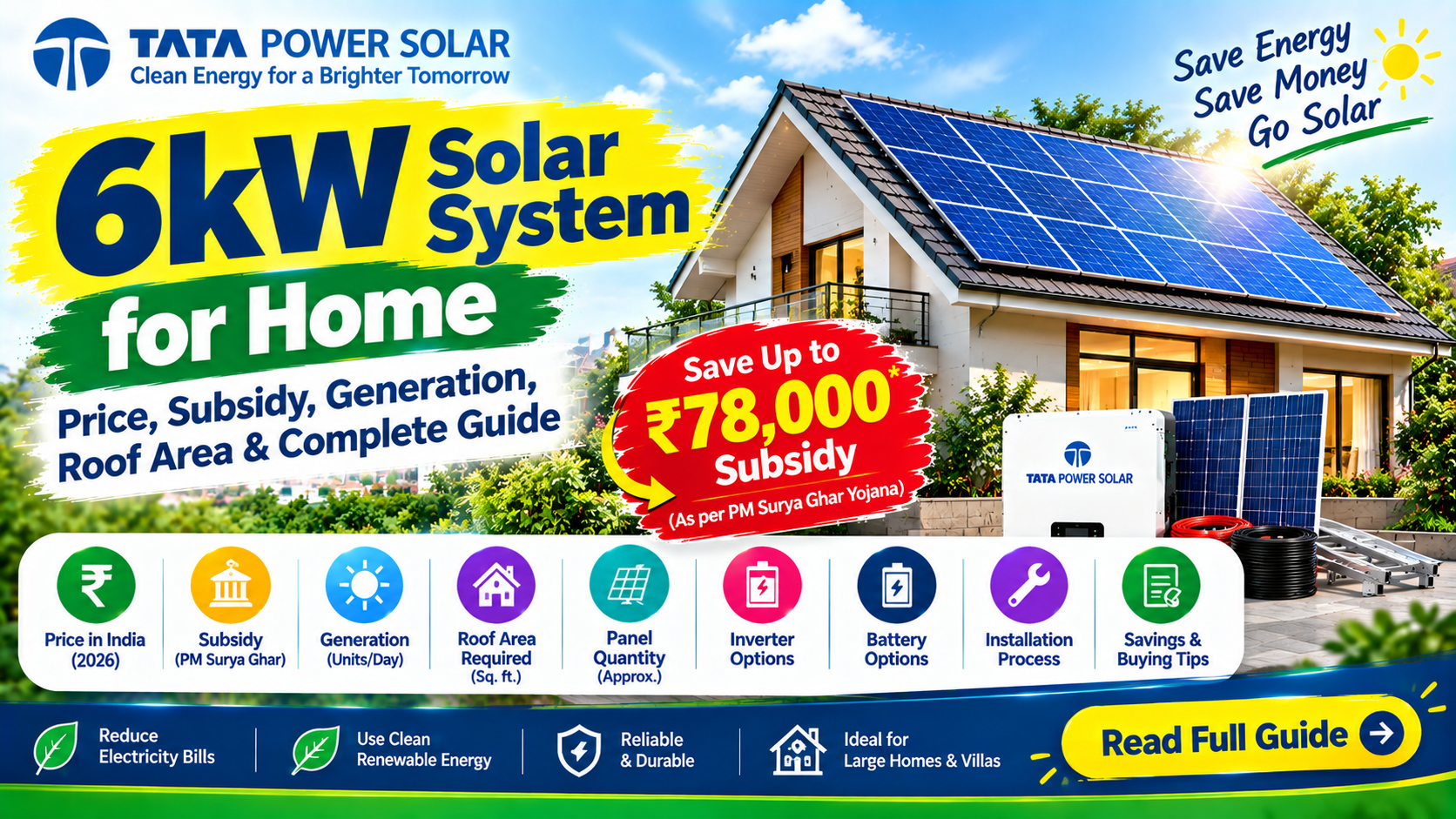
A 6kW solar system for home can be a suitable option for households with relatively high electricity consumption. Larger homes, villas and properties with multiple air conditioners, refrigerators, water pumps, geysers and other appliances may consider a 6kW rooftop solar system after reviewing their actual electricity usage.
But choosing the right solar system is about more than simply selecting a 6kW capacity.
You need to understand price, subsidy, electricity generation, roof area, panels, inverter, installation, battery options, maintenance and expected savings before making a purchase.
This detailed guide explains everything you should know about a 6kW solar system in India in 2026.
What Is a 6kW Solar System?
A 6kW solar system is a rooftop solar power system with approximately 6 kilowatts of installed solar generation capacity.
A typical system can include:
- Solar panels
- Solar inverter
- Mounting structure
- DC cables
- AC cables
- DC/AC protection equipment
- Earthing system
- Lightning protection where required
- Monitoring system
- Installation and commissioning
- Net-metering-related equipment where applicable
- Battery storage for hybrid/off-grid configurations
The exact number of panels depends on the wattage of the selected modules.
For example, a 6kW system could use approximately:
- 10 × 600W panels = 6kW
- 11 × 550W panels = 6.05kW
- 12 × 500W panels = 6kW
The final module configuration should be designed according to the inverter, roof layout and project requirements.
6kW Solar System Price in India 2026
There is no single nationwide fixed price for a 6kW solar system.
The final cost depends on:
- Solar panel brand
- Panel technology
- Panel wattage
- Inverter brand
- Inverter capacity
- Mounting structure
- Protection equipment
- Cable quality
- Installation conditions
- Roof height and accessibility
- Net-metering requirements
- Battery capacity, if applicable
- Location and local taxes
For a 6kW on-grid residential system, a practical market-planning range can be around ₹3.5 lakh to ₹4.5 lakh or more before applicable subsidy, depending on the equipment and installation specification.
A premium system using higher-specification modules, advanced inverter technology or additional equipment can cost more.
Indicative 6kW System Cost
| Configuration | Indicative Planning Cost |
|---|---|
| 6kW On-Grid | ₹3.5–₹4.5 lakh+ |
| 6kW Hybrid | ₹5 lakh+ depending on battery |
| 6kW Off-Grid | ₹5 lakh+ depending on battery |
| Premium 6kW System | Depends on components |
These figures are indicative planning ranges, not fixed quotations. Always request a detailed site-specific quotation before making a purchase.
Is There a Subsidy for a 6kW Solar System?
Yes, eligible residential consumers can be covered under the PM Surya Ghar: Muft Bijli Yojana, subject to the scheme's applicable rules and installation requirements.
The published CFA structure provides:
- ₹30,000/kW for the first 2kW
- ₹18,000 for the additional 1kW
- No additional central CFA beyond 3kW
This means the published maximum central CFA for a residential rooftop system of 3kW or more is ₹78,000. A 6kW system therefore does not receive an additional ₹18,000 for every kW above 3kW under this structure.
Example
Suppose:
6kW system price: ₹3,80,000
Maximum published central CFA: ₹78,000
Illustrative balance: ₹3,02,000
This is only an example. Your actual payable amount depends on the final quotation, eligible system components, applicable taxes, installation charges and scheme eligibility.
The PM Surya Ghar implementation period in the published operational guidelines extends to 31 March 2027.
Because government schemes can be amended, always verify the current subsidy process and eligibility before placing an order.
How Much Electricity Does a 6kW Solar System Generate?
Solar generation varies according to:
- Location
- Solar irradiation
- Weather
- Season
- Panel orientation
- Panel tilt
- Shading
- Temperature
- Dust
- System losses
- Inverter performance
- Maintenance
For planning purposes, a 6kW rooftop system may generate approximately:
| Period | Approximate Generation |
|---|---|
| Daily | 21–30 units |
| Monthly | 630–900 units |
| Yearly | 7,500–10,800 units |
These are planning estimates, not guaranteed generation figures.
A properly designed system in a location with good solar exposure may perform differently from the same-capacity system installed under partial shade or unfavorable roof conditions.
How Much Roof Area Is Required for a 6kW Solar System?
A 6kW solar system may require approximately 550–700 sq. ft. of usable roof area, depending on:
- Panel dimensions
- Panel wattage
- Mounting arrangement
- Roof shape
- Maintenance pathways
- Shading
- Setbacks
- Water tanks and other obstacles
Higher-wattage panels can reduce the number of modules required and may help optimize roof space.
However, roof area should not be calculated only from the panel footprint. The installer should account for spacing, access, maintenance and shading.
How Many Solar Panels Are Needed for 6kW?
The number of panels depends on individual panel capacity.
Example configurations
550W panels
6,000 ÷ 550 ≈ 10.9
So approximately 11 panels may be used, resulting in around 6.05kW DC capacity.
500W panels
6,000 ÷ 500 = 12
So approximately 12 panels are required.
600W panels
6,000 ÷ 600 = 10
So approximately 10 panels can provide 6kW.
The final design should be confirmed by the installer based on module specifications and inverter design.
What Components Are Included in a 6kW Solar System?
1. Solar Panels
Solar panels are responsible for converting sunlight into DC electricity.
When comparing panels, check:
- Manufacturer
- Model
- Wattage
- Efficiency
- Product warranty
- Performance warranty
- Temperature coefficient
- Certification and applicable standards
2. Solar Inverter
The inverter converts DC electricity from the solar panels into AC electricity used by household appliances.
For a 6kW system, inverter selection should be based on:
- Solar array size
- AC capacity
- MPPT configuration
- Grid requirements
- Battery requirements
- Monitoring capabilities
3. Mounting Structure
The mounting structure holds the solar modules securely on the roof.
The structure should be selected according to:
- Roof type
- Wind conditions
- Panel dimensions
- Corrosion environment
- Installation method
4. Protection Equipment
A properly designed system may include:
- DC isolator
- AC isolator
- Surge protection
- Appropriate circuit protection
- Earthing
- Lightning protection where required
5. Monitoring System
A modern solar monitoring system can help homeowners track:
- Daily generation
- Monthly generation
- Lifetime generation
- Inverter status
- System alerts
- Performance trends
6kW On-Grid Solar System
An on-grid solar system operates together with the utility electricity grid.
During the day, solar electricity can power household loads. Depending on the approved metering arrangement and applicable local rules, surplus electricity can be exported to the grid.
Benefits
- Lower initial cost than many battery-based systems
- No large battery bank
- Suitable for reducing electricity bills
- Easy monitoring
- Good option for properties with reliable grid electricity
Important limitation
A conventional on-grid solar system generally does not provide backup power during a grid outage.
6kW Hybrid Solar System
A 6kW hybrid solar system combines solar generation, grid electricity and battery storage.
It can be considered by homeowners who want both:
Solar savings + backup electricity
A hybrid system can be useful when:
- Power cuts are frequent
- Backup electricity is important
- You want to store excess solar energy
- Certain appliances need backup power
The battery significantly affects the total project cost.
6kW Off-Grid Solar System
An off-grid system is designed to operate without depending on the utility grid.
A typical off-grid system requires:
- 6kW solar array
- Solar inverter
- Battery bank
- Mounting structure
- Protection equipment
- Cabling
Battery sizing becomes particularly important because the stored energy must support the required loads when solar generation is unavailable.
Who Should Consider a 6kW Solar System?
A 6kW system may be worth evaluating for:
- Large homes
- Villas
- 4BHK/5BHK homes
- Homes with multiple air conditioners
- Homes with high monthly electricity consumption
- Properties with water pumps
- Homes planning EV charging
- Properties with large daytime electricity loads
- Homeowners with sufficient rooftop space
However, the number of bedrooms alone should not determine solar capacity.
Your electricity bills provide a much better starting point.
How to Decide Whether You Need 6kW Solar
Review your electricity consumption for at least several months.
For example, if your home regularly consumes a high amount of electricity because of:
- Multiple ACs
- Electric water heaters
- Refrigerators
- Washing machines
- Water pumps
- Home office equipment
- EV charging
then a larger solar system may be appropriate.
You should also consider future electricity consumption.
If you are planning to purchase an EV or install additional appliances, include those future loads in the solar sizing discussion.
When Should You Install a 6kW Solar System?
The right time depends on:
- Electricity consumption
- Roof availability
- Budget
- Local DISCOM process
- Subsidy eligibility
- Property ownership
- Future electricity requirements
If your electricity consumption is already high, a professional solar assessment can help determine whether 6kW is appropriate or whether another capacity would better match your usage.
Where Can a 6kW Solar System Be Installed?
A 6kW rooftop system can potentially be installed on:
- Independent houses
- Villas
- Bungalows
- Large residential properties
- Farmhouses
- Small commercial properties
- Offices
- Shops
- Other suitable buildings
For a residential subsidy, however, eligibility depends on the applicable government scheme and consumer category.
How Does a 6kW Solar System Work?
The basic process is:
Sunlight → Solar Panels → DC Electricity → Solar Inverter → AC Electricity → Home Appliances
During daylight hours, solar electricity can directly supply household appliances.
If generation exceeds the property's immediate consumption, surplus energy may be exported according to the applicable metering arrangement.
At night, the system can use:
- Grid electricity in an on-grid system, or
- Battery energy in a hybrid/off-grid system.
How Much Can You Save With a 6kW Solar System?
Savings depend on:
- Solar generation
- Electricity tariff
- Self-consumption
- Export arrangement
- Local electricity regulations
- Seasonal generation
- System performance
For example, if a system generates around 700 units in a particular month and much of that energy offsets electricity that would otherwise have been purchased from the grid, the potential bill reduction can be significant.
However, solar generation is not the same as bill savings.
A professional financial assessment should use your actual electricity bills and local tariff structure.
6kW Solar System With Battery: How Much Battery Do You Need?
There is no universal battery size for every 6kW system.
Battery capacity should be based on:
Required backup load × Backup duration
For example, if you want to operate:
- Lights
- Fans
- Wi-Fi
- Refrigerator
- Selected appliances
during a power cut, your battery requirement will be different from a homeowner who wants to run:
- Multiple ACs
- Water pumps
- Geysers
- Kitchen appliances
- EV chargers
during an outage.
Always size the battery around the essential loads you actually want to back up.
6kW Solar System Installation Process
A typical installation process includes:
Step 1: Electricity Bill Analysis
The installer reviews your electricity consumption.
Step 2: Site Survey
The roof is inspected for:
- Area
- Shading
- Orientation
- Structural conditions
- Cable routing
- Electrical connection
Step 3: System Design
The installer determines:
- Panel quantity
- Panel arrangement
- Inverter
- Structure
- Protection
- Cable requirements
Step 4: Quotation
The quotation should clearly show the equipment and services included.
Step 5: Installation
Panels, structure, inverter, cables and protection equipment are installed.
Step 6: Testing
The system is tested for safe and correct operation.
Step 7: Grid/Metering Process
Where applicable, the required DISCOM and metering process is completed.
Step 8: Commissioning
The system is activated and monitoring is configured.
Maintenance of a 6kW Solar System
Solar systems generally require relatively simple maintenance, but regular inspection helps maintain performance.
Recommended activities include:
- Check panels for dirt
- Inspect visible cables
- Monitor inverter alerts
- Check generation regularly
- Inspect mounting structure
- Check protection equipment
- Monitor unusual drops in generation
- Arrange professional electrical inspection when required
Cleaning frequency depends on the local environment.
Areas with dust, construction activity or pollution may require more frequent cleaning than cleaner locations.
Common Mistakes When Buying a 6kW Solar System
Avoid these mistakes:
- Selecting capacity only by house size.
- Buying based only on the lowest quotation.
- Ignoring shading.
- Not checking inverter specifications.
- Not checking warranty terms.
- Assuming 6kW means 6 units every hour regardless of conditions.
- Assuming generation is identical every month.
- Confusing on-grid solar with battery backup.
- Choosing an oversized battery without calculating loads.
- Not checking the current subsidy process.
- Not comparing complete quotations.
- Ignoring after-sales service.
6kW Solar System Buying Checklist
Before placing your order, verify:
- Solar panel brand
- Panel model
- Panel wattage
- Panel warranty
- Inverter brand
- Inverter capacity
- MPPT configuration
- Mounting structure
- DC/AC protection
- Earthing
- Lightning protection
- Cabling
- Monitoring
- Installation
- Commissioning
- Net-metering assistance
- Subsidy process
- Warranty documentation
- After-sales service
- Final project cost
Frequently Asked Questions
1. What is the price of a 6kW solar system in India in 2026?
A 6kW on-grid residential system can be planned at approximately ₹3.5 lakh–₹4.5 lakh or more before applicable subsidy, depending on the equipment, location and installation requirements.
2. What is the subsidy for a 6kW solar system?
Under the published PM Surya Ghar residential CFA structure, the maximum central CFA for systems of 3kW or larger is ₹78,000. There is no additional central CFA for capacity beyond 3kW under that published structure.
3. How many units does a 6kW solar system generate per day?
A 6kW system may generate approximately 21–30 units per day under suitable conditions. Actual production varies with location, weather, shading and system design.
4. How much roof area is required for 6kW solar?
A reasonable planning estimate is around 550–700 sq. ft. of usable roof area, although the exact requirement depends on panel dimensions and installation layout.
5. How many solar panels are required for 6kW?
Depending on panel wattage, approximately 10–12 panels may be required. For example, ten 600W panels provide 6kW of DC capacity.
6. Is 6kW enough for a 4BHK house?
It can be suitable for some 4BHK homes, but the correct capacity should be determined from actual electricity consumption rather than the number of bedrooms.
7. Can a 6kW solar system run multiple ACs?
A 6kW solar system can contribute substantially to household electricity consumption, but the actual ability to run multiple ACs depends on their capacity, simultaneous load, solar generation, inverter configuration and grid connection.
8. Can a 6kW solar system charge an EV?
Yes, solar electricity can contribute to EV charging. However, EV charging can add substantial electrical demand, so the system should be sized after considering both household consumption and vehicle charging requirements.
9. Does a 6kW on-grid system work during a power cut?
A conventional on-grid system normally shuts down when the utility grid fails. Backup functionality requires an appropriately designed hybrid or battery-backed system.
10. Is a battery necessary for a 6kW solar system?
No. A battery is not necessarily required for an on-grid system. Batteries are mainly considered when energy storage or backup power is required.
11. How long can a 6kW solar system last?
The useful life depends on the quality of components, installation, environment and maintenance. Solar panels are generally designed for long-term operation, while inverters and batteries may have different replacement timelines and warranties.
12. How do I get an accurate 6kW solar quotation?
Share your recent electricity bills and property details with a qualified installer. Ask for a site survey and a complete quotation listing panels, inverter, structure, protection, installation, warranties, applicable subsidy and any metering-related costs.
Conclusion
A 6kW solar system for home can be an option for households with relatively high electricity consumption and adequate rooftop space.
A 6kW system may generate approximately 21–30 units per day under suitable conditions, although actual production varies by location and system design.
For residential consumers, the published PM Surya Ghar CFA structure provides up to ₹78,000 of central CFA, with no additional central CFA beyond 3kW under that structure.
Before buying, compare more than just the price. Evaluate:
Panel quality + inverter + installation + warranty + generation + after-sales service + subsidy eligibility.
A properly designed 6kW rooftop solar system can help large households generate their own electricity, reduce dependence on grid power and move toward cleaner energy.
Found this useful?
Share this solar business article.