
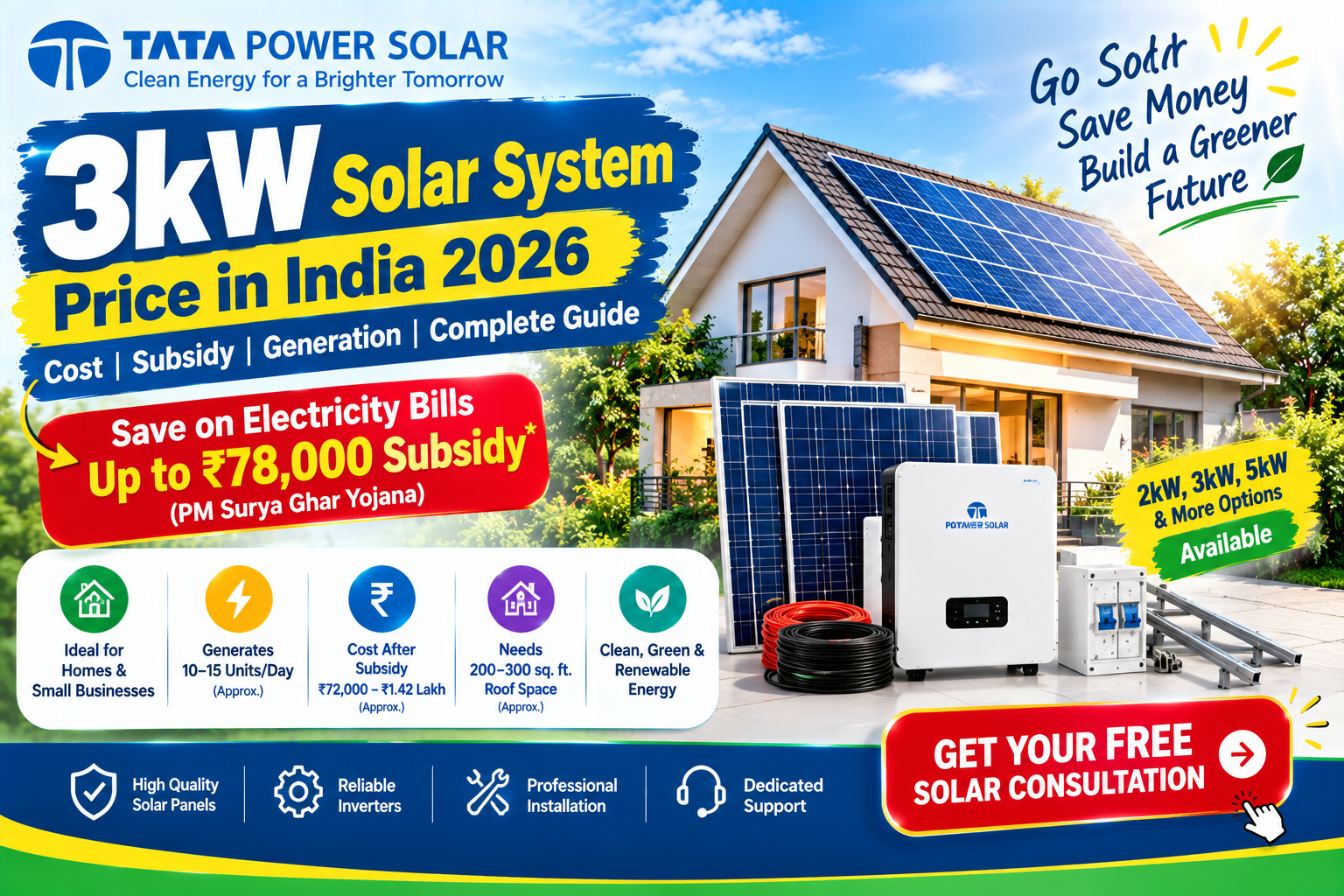
The 3kW solar system is one of the most searched residential solar solutions in India. Homeowners searching for 3kW solar system price in India, 3kW solar panel price, 3kW solar system cost after subsidy, and 3kW rooftop solar system for home are usually looking for a practical system capable of covering a significant portion of household electricity consumption.
A 3kW solar system can be installed as an on-grid, off-grid or hybrid solar system, depending on whether your priority is electricity-bill reduction, backup power or energy independence.
In this detailed guide, we cover the What, Why, Who, Where, When and How of a 3kW solar system so you can understand the cost and make an informed purchase.
What Is a 3kW Solar System?
A 3kW solar system is a rooftop solar power system with a rated capacity of approximately 3 kilowatts.
It normally consists of:
- Solar panels
- 3kW solar inverter
- Mounting structure
- DC and AC cables
- Protection equipment
- Earthing
- Surge protection
- Monitoring system
- Installation and commissioning
Solar panels convert sunlight into DC electricity. The inverter converts the electricity into AC power that can be used by household appliances.
For an on-grid system, surplus electricity can be exported to the electricity grid according to the applicable state/DISCOM rules.
3kW Solar System Price in India in 2026
The 3kW solar system price in India varies according to the panel brand, inverter, technology, installation location, mounting structure and scope of work.
Current 2026 market references put installed residential 3kW on-grid systems broadly around ₹1.5 lakh to ₹2.2 lakh before subsidy, although actual quotations can fall outside this range.
| System | Indicative Price Before Subsidy | Subsidy / CFA* | Indicative Cost After Subsidy |
|---|---|---|---|
| 3kW On-Grid | ₹1.5–₹2.2 lakh | Up to ₹78,000 | ₹72,000–₹1.42 lakh |
| 3kW Hybrid | Higher | Subject to eligibility | Depends on battery/system |
| 3kW Off-Grid | Higher | Depends on applicable rules | Depends on battery |
*For eligible residential consumers under the applicable PM Surya Ghar framework.
Important: These are planning ranges, not fixed market prices. Your final quotation should clearly mention the panel model, inverter model, mounting structure, installation, electrical work, taxes and other charges.
3kW Solar System Subsidy in India
One of the biggest reasons homeowners search for a 3kW solar system with subsidy is the PM Surya Ghar: Muft Bijli Yojana.
The Government of India's scheme order specifies Central Financial Assistance for residential rooftop solar as:
- ₹30,000/kW for the first 2kW
- ₹18,000 for the additional 1kW
- No additional CFA beyond 3kW under the stated structure
This gives a maximum central CFA of ₹78,000 for a 3kW residential system, subject to the applicable eligibility and implementation requirements.
The National Rooftop Solar Portal also provides information about the application process, DISCOMs and rooftop-solar implementation.
Does Every 3kW System Get ₹78,000?
Not automatically.
The consumer must meet the applicable scheme requirements, use the prescribed process and complete installation/verification requirements.
The final subsidy should therefore be confirmed through the official portal and relevant DISCOM process before calculating the final investment.
3kW Solar System Price After Subsidy
Suppose a complete 3kW solar system quotation is:
₹1,80,000
If an eligible residential consumer receives the full central CFA of:
₹78,000
The indicative remaining system cost would be:
₹1,80,000 − ₹78,000 = ₹1,02,000
Similarly, if the system quotation is ₹2,00,000, the indicative remaining amount after ₹78,000 CFA would be ₹1,22,000.
This is why comparing the complete system quotation is important rather than comparing only the price of solar panels.
How Much Electricity Does a 3kW Solar System Generate?
A 3kW solar system can produce approximately 10–15 units of electricity per day under suitable conditions, with actual production changing according to location, season, weather, shading, panel orientation and system efficiency. Current 2026 market references commonly estimate around 300–450 units per month depending on conditions.
A simplified planning range is:
| Period | Approximate Generation |
|---|---|
| Per Day | 10–15 units |
| Per Month | 300–450 units |
| Per Year | 3,600–5,400 units |
These figures are estimates, not guaranteed generation.
A professional installer should evaluate your location and roof before promising a specific generation figure.
How Much Roof Space Is Required for a 3kW Solar System?
A 3kW rooftop solar installation generally needs approximately 200–300 sq. ft. of usable roof area, depending on module wattage, panel layout, spacing and mounting arrangement. Current market references commonly quote roughly 200–300 sq. ft. for a residential 3kW system.
The roof should ideally have:
- Good sunlight exposure
- Minimal shading
- Adequate structural strength
- Suitable orientation
- Enough clearance for maintenance
Objects such as water tanks, trees, neighbouring buildings and parapet walls should be considered during the site survey.
What Components Are Included in a 3kW Solar System?
1. Solar Panels
Solar panels are responsible for converting sunlight into electricity.
Depending on the selected module wattage, a 3kW system may use different numbers of panels.
For example, the final panel count depends on whether the installer uses approximately 400W, 500W, 540W or higher-wattage modules.
2. 3kW Solar Inverter
The solar inverter converts DC electricity from the panels into AC electricity.
The inverter should be selected according to:
- System capacity
- Panel configuration
- MPPT requirements
- Grid requirements
- Monitoring requirements
- Warranty
- Protection features
3. Mounting Structure
The structure holds the solar panels securely on the roof.
A good structure should be appropriate for:
- Roof type
- Wind conditions
- Panel layout
- Corrosion protection
- Installation environment
4. Solar Cables and Connectors
A complete system requires appropriate DC and AC cabling, connectors and cable management.
Poor-quality cables can create safety and performance problems.
5. Protection Equipment
A professional installation may include:
- DC protection
- AC protection
- MCBs
- Surge protection
- Isolators
- Earthing
- Lightning protection where required
6. Solar Monitoring
Many modern inverters provide monitoring through a mobile application or web dashboard.
You can monitor:
- Daily generation
- Monthly generation
- Historical production
- Inverter status
- System alerts
On-Grid vs Hybrid vs Off-Grid 3kW Solar System
Choosing the correct system type is an important part of calculating the 3kW solar system cost.
| Feature | On-Grid | Hybrid | Off-Grid |
|---|---|---|---|
| Grid connection | Yes | Yes | Usually no |
| Battery | Usually no | Yes | Yes |
| Backup during outage | Generally no | Yes, depending on design | Yes |
| Initial cost | Lower | Higher | Higher |
| Main purpose | Bill reduction | Bill reduction + backup | Independent power |
| Net metering | Subject to local rules | Subject to configuration/rules | Generally not applicable |
3kW On-Grid Solar System
An on-grid system is generally suitable for homeowners whose main goal is reducing electricity bills while remaining connected to the utility grid.
3kW Hybrid Solar System
A hybrid system combines solar generation with battery storage and grid connectivity.
It can be considered where backup power is an important requirement.
3kW Off-Grid Solar System
An off-grid system is designed to operate independently of the utility grid and normally requires battery storage.
It can be useful in locations where reliable grid electricity is unavailable.
Who Should Consider a 3kW Solar System?
A 3kW system can be considered by households with moderate-to-high electricity consumption.
It may suit:
- 2BHK homes
- 3BHK homes
- Independent houses
- Villas
- Small offices
- Small shops
- Homes using multiple electrical appliances
However, system capacity should be based on actual electricity consumption, not simply the number of bedrooms.
How to Know If 3kW Solar Is Enough for Your Home
Look at your electricity bills for the previous 6–12 months.
Check:
- Monthly units consumed
- Average electricity bill
- Daytime consumption
- Number of air conditioners
- Refrigerator usage
- Water pump
- Geyser
- Washing machine
- Future EV charging
- Future appliances
For example, a household consuming around 300–400 units per month may find a 3kW system worth evaluating, but the exact sizing should be based on site-specific generation and consumption data.
Can a 3kW Solar System Run an AC?
This is one of the most common questions about a 3kW solar system for home.
The answer depends on:
- AC capacity
- AC efficiency
- Solar generation at that moment
- Other appliances running simultaneously
- Inverter capacity
- Grid connection
- Battery configuration
A 3kW solar system should not be interpreted as meaning that a home can operate unlimited loads totaling 3kW continuously.
If you regularly use multiple ACs, an EV charger, electric geysers and other high-load appliances, you may need to evaluate a larger system.
How Much Can a 3kW Solar System Save?
Solar savings depend on:
- Electricity tariff
- Monthly consumption
- Solar generation
- Self-consumption
- Net-metering arrangement
- System cost
- Subsidy eligibility
For example, if a system generates 350 units in a month and the effective avoided electricity cost is ₹8 per unit, the theoretical value of that generation would be:
350 × ₹8 = ₹2,800
This is only an illustration. Actual savings depend on your electricity tariff, consumption pattern and applicable billing rules.
3kW Solar System Installation Process
Installing a rooftop solar system generally involves several stages.
Step 1: Electricity Bill Analysis
Your installer reviews your electricity consumption.
Step 2: Roof Survey
The site is checked for:
- Area
- Shade
- Orientation
- Roof condition
- Structural requirements
Step 3: System Design
The installer determines the appropriate panel configuration and inverter.
Step 4: Quotation
The quotation should clearly identify all equipment and services.
Step 5: Government/DISCOM Process
Where applicable, the required rooftop-solar application and DISCOM procedures are completed.
Step 6: Installation
Panels, structure, inverter, wiring and protection equipment are installed.
Step 7: Testing
The system is inspected and commissioned.
Step 8: Monitoring
Generation can then be tracked through the inverter/app and electricity meter.
What Should a 3kW Solar Quotation Include?
Before purchasing, ask for a detailed quotation containing:
Solar Panels
- Brand
- Model
- Wattage
- Technology
- Quantity
- Warranty
Inverter
- Brand
- Model
- Capacity
- MPPT details
- Warranty
- Monitoring
Structure
- Material
- Galvanization/corrosion protection
- Roof mounting details
Electrical
- DC cables
- AC cables
- Protection devices
- Earthing
- Surge protection
Installation
- Labour
- Transportation
- Commissioning
- Documentation
Government Process
Clearly identify which subsidy, DISCOM or net-metering services are included and which are not.
Factors That Affect 3kW Solar System Price
The price can vary because of several factors.
Panel Technology
Different panel technologies and efficiencies can have different costs.
Inverter Brand
Inverter pricing varies based on technology, warranty, monitoring and features.
Roof Condition
A simple roof may have lower installation complexity than a difficult or high-rise roof.
Cable Length
Long cable routes can increase material and installation requirements.
Structure
Heavy-duty or specialised mounting structures can increase cost.
Battery
Adding a battery can significantly increase the price of a hybrid or off-grid system.
Location
Installation prices and local processes vary by city and state.
Common Mistakes When Buying a 3kW Solar System
Avoid these common mistakes:
- Choosing the cheapest quotation without comparing specifications
- Focusing only on solar panel price
- Ignoring the inverter
- Not checking warranty terms
- Installing panels in shaded areas
- Not checking roof condition
- Assuming advertised generation is guaranteed
- Assuming every system automatically receives subsidy
- Not checking the DISCOM process
- Not asking what is included in installation
- Not checking after-sales support
3kW Solar System Maintenance
Solar systems generally require relatively low routine maintenance, but they should not be completely ignored.
Regularly check:
- Panel cleanliness
- Visible cable damage
- Inverter alerts
- Mounting structure
- Generation data
- Electrical protection
- Shading from newly grown trees
If generation suddenly decreases, check the monitoring system and contact the installer or qualified technician.
Why Choose a 3kW Solar System?
A 3kW system can offer several advantages:
Lower Electricity Bills
Solar generation can reduce the amount of electricity purchased from the grid.
Renewable Energy
Solar power generates electricity without fuel combustion at the point of generation.
Long-Term Investment
Solar panels are designed for long-term operation, while individual component warranties vary.
Government Support
Eligible residential consumers can benefit from the applicable PM Surya Ghar CFA structure.
Scalable Planning
If your electricity demand is expected to increase, you can discuss future capacity requirements with your installer before installation.
Frequently Asked Questions
1. What is the 3kW solar system price in India in 2026?
Current market references broadly indicate around ₹1.5 lakh–₹2.2 lakh before subsidy for residential on-grid installations, but actual quotations depend on equipment, location and installation requirements.
2. What is the 3kW solar system price after subsidy?
If an eligible system receives the full ₹78,000 central CFA, a ₹1.5 lakh–₹2.2 lakh system would have an indicative remaining cost of approximately ₹72,000–₹1.42 lakh.
3. How much subsidy is available for a 3kW solar system?
Under the PM Surya Ghar residential CFA structure, the maximum central assistance reaches ₹78,000 at 3kW, subject to applicable requirements.
4. How many units does a 3kW solar system generate?
A 3kW system can generate roughly 10–15 units per day under favorable conditions. Actual generation varies by location, season, weather, shading and system design.
5. How much roof area is needed for 3kW solar?
Approximately 200–300 sq. ft. of usable roof area may be required, depending on panel wattage and layout.
6. Can a 3kW solar system run a 1.5-ton AC?
It may be possible under suitable conditions, but the actual load must be evaluated along with other appliances operating simultaneously.
7. Is a battery required for a 3kW solar system?
No. A standard on-grid system generally does not require a battery. Batteries are primarily used when backup or energy storage is required.
8. Is a 3kW on-grid system better than a hybrid system?
They serve different purposes. An on-grid system focuses on grid-connected solar generation and bill reduction, while a hybrid system adds battery storage for backup and energy management.
9. How many solar panels are needed for 3kW?
The number depends on the wattage of each panel. For example, six panels rated around 500W each would provide approximately 3kW of nominal capacity.
10. Is 3kW enough for a 3BHK home?
It can be suitable for some 3BHK homes, but the correct capacity depends on actual electricity consumption and future loads rather than house size alone.
Final Conclusion
The 3kW solar system price in India in 2026 can vary significantly depending on the panels, inverter, installation location, mounting structure, electrical work and system type.
For eligible residential consumers, the PM Surya Ghar framework provides central financial assistance that reaches ₹78,000 for a 3kW system, subject to applicable scheme requirements.
A 3kW solar system can be a practical option for households with moderate electricity consumption, but the right system should be selected after reviewing your electricity bills, roof space, shading, appliance usage and future power requirements.
Before purchasing, compare complete quotations—not just the advertised solar panel price—and verify the applicable subsidy and DISCOM process.
Found this useful?
Share this solar business article.